This leads us to The Testaments, which picks up around four years later. The show is based on Margaret Atwood’s own sequel novel of the same name, though several changes are made – including the timeline, with the book 15 years after the end of The Handmaid’s Tale novel – which is a result of how Hulu’s original hit series continued June’s story long beyond its conclusion on the page. Still, it’s the same setup: the story shifts its focus to two young girls, Agnes, played by Chase Infiniti, a Plum (a Commander’s daughter waiting to come of age and be married), and Daisy, played by Lucy Halliday, a newly-recruited Pearl Girl (missionaries who preach the word of Gilead and train to become Aunts).
Returning from The Handmaid’s Tale is Aunt Lydia (Ann Dowd), who, despite helping June at the end of that series, is still working within Gilead at this point and oversees Agnes, Daisy, and many girls like them. Throughout the show’s 10 episodes, those three characters will come together in surprising, dramatic ways that allow The Testaments to live up to the original, while striving to do its own thing.
Rating: 4/5
Pros
Cons
Chase Infiniti confirms she’s a star with a fantastic lead performance
The pacing is a little off, with some story elements drawn out
Lucy Halliday and the rest of the show’s younger cast are also great
Some of the adult characters are one-note
The cinematography is just as gorgeous as The Handmaid’s Tale…
…But the YA-tinged, twisted fairy tale narrative makes this feel fresh and distinct
The Testaments Is More Than Just A Handmaid’s Tale Sequel
Image via Hulu
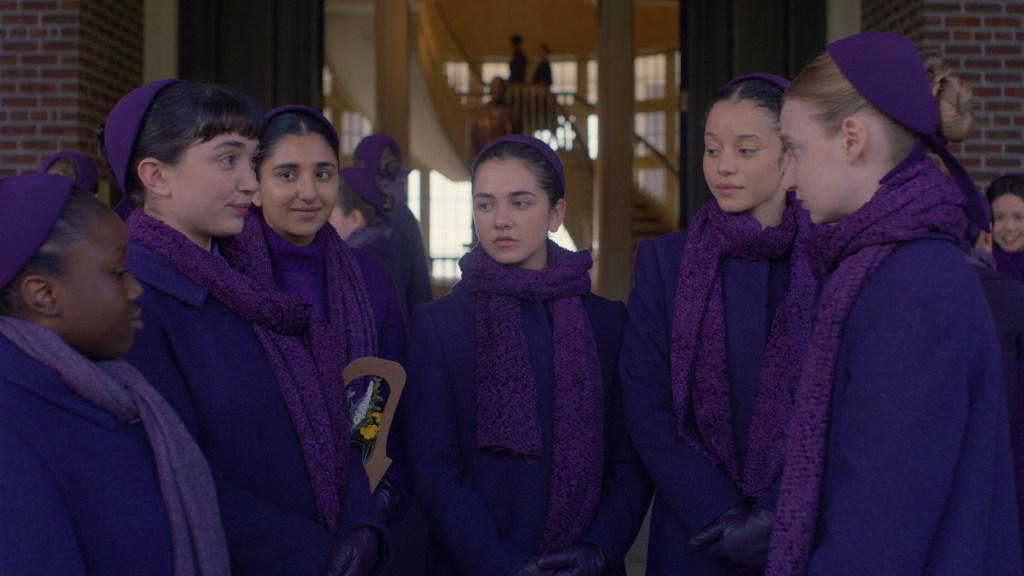
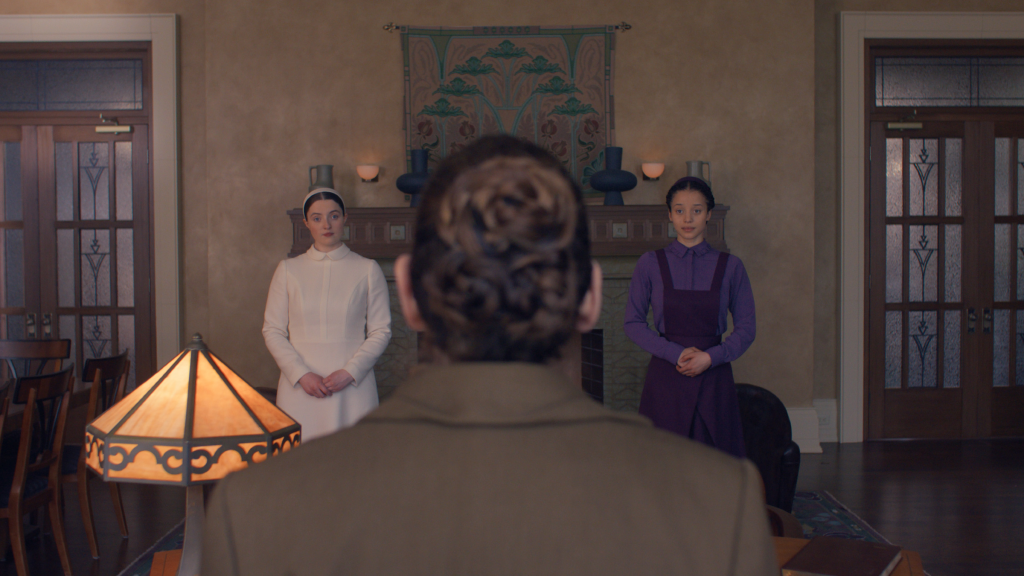
The Testaments has some similarities to The Handmaid’s Tale, which is to be expected. It’s based on a sequel book from the same author and has the same series creator, Bruce Miller. Dowd returns as Lydia, and some elements of Gilead feel familiar, despite the passage of time. Despite the losses in Boston, this is still a cruel world ruled by cruel men. Some of the hallmarks of The Handmaid’s Tale are present here: an extremely striking use of color (though with purple replacing red), gorgeous cinematography (including some stunning overhead shots and imagery of the girls together that reminded me a lot of its parent series), and several well-placed needle drops.
And yet, in story and tone, this is different, and it commendably strives to forge its own identity rather than just playing the hits from its predecessor (though some of the early worldbuilding might be frustratingly familiar for returning audiences). Because we’re following Agnes and Daisy at school, on the path to womanhood, this is effectively a coming-of-age narrative. There’s a lightness within that, which stands in stark contrast to The Handmaid’s Tale. These girls have genuine friendships, moments of silliness and real sweetness, schoolyard crushes and squabbles, and it’s a change that makes the series feel fresh and revitalized.
Some of the later seasons of The Handmaid’s Tale became a little frustrating in their repetitive focus on June escaping and re-entering Gilead, and drew criticism for often veering into torture porn with how graphic its violence could be, though it did serve the story. It’s undoubtedly helped by once again having Atwood’s source material to adapt, something the show didn’t have beyond its first season, but also by its shift in perspective. These are teenage girls, and most of them are much higher-up in society than the Handmaids, so that demands a different, lighter tone. Atwood’s novel is YA-tinged, and that’s impressively carried through here.
That isn’t to say things still aren’t grim. Gilead remains evil, even if in this case, it’s a little less obvious, and lurks beneath the surface more. It’s a world in which a girl getting their period decides their future; where a trip to the dentist is something to really be afraid of; where a marriage match may feel like a death sentence. There isn’t as much clear brutality and graphic violence, but there’s still a horrifying sense of oppression, it just takes a while for the girls to realize it, as their fairy tale crumbles into twisted reality.
It’s a different side to Gilead, but one that’s just as ugly and relevant, and indeed, in the occasional moments that the story feels more like The Handmaid’s Tale, it becomes a little less interesting. I also think the pacing here could be improved – the middle of the season does have some repetitive material where it feels like it’s just keeping the wheels turning on a couple of the storylines, but for the most part, it works well.
Chase Infiniti & Lucy Halliday Shine In The Testaments
Image via Hulu
The Testaments timed things incredibly well with the casting of Chase Infiniti, who was brought on as Agnes before her breakout role in One Battle After Another, which catapulted her into awards season with nominations at the Golden Globes, BAFTAs, and Actor Awards. It also got things incredibly right, because Infiniti is fantastic as Agnes. It was clear from One Battle, and it’s even more apparent here, that she is an absolute star.
Her performance as Agnes is one of restraint. She’s been raised to be the perfect, dutiful young woman, and it’s a part within Gilead that she plays well. She’s learned not to speak out of turn, so instead she says a lot with her eyes and other microexpressions. The greatness is in the quiet discomfort and forced pleasantries, in her having to fake a smile while her world turns into a nightmare, and Infiniti does it brilliantly, making you immediately warm to and care for Agnes. There are moments when the restraint breaks, which vary between devastation and a rebellious spirit that would make June proud.
Speaking of rebellious, Lucy Halliday is also great as Daisy, the newcomer into the world of Gilead, who is guided by Agnes, but in turn, guides her with some talk of the outside world (she comes into it from Toronto). They play off each other perfectly, and there’s a real authenticity as their bond begins to strengthen. Halliday’s status as an outsider means there’s a duality to her performance: the girl who knows the real world, and the girl who has to fit in to Gilead, which she plays wonderfully. There’s a wide-eyed shock and fiery rage within her that’s reminiscent of Moss’ performance as June, but without ever feeling like it’s an imitation of that.
The rest of the younger cast is great, too, with the likes of Rowan Blanchard as the pampered Shunammite and Mattea Conforti as Becka, Agnes’ best friend, both getting moments to shine. For her part, Dowd steps back into the role of Aunt Lydia as though she’d never been away – which, really, she hasn’t – though I did find myself wanting more of her character and those interactions with Agnes and Daisy. With the focus on the kids, I also found a lot of the other Aunts, as well as some of the other adult characters, weren’t quite as interesting or well-developed, though it’s an understandable trade-off.
On the whole, if you liked The Handmaid’s Tale, you’ll like The Testaments. And even if you tired of the former a little, there’s more than enough here that’s fresh, different, and compelling to make it worth coming back for.
The first three episodes of The Testaments will be released on April 8th on Hulu.