The bedrock of Rick and Morty‘s identity has always been its adversarial relationship with the science fiction canon. The show treats ideas that have driven entire careers of speculative fiction as comedic raw material, constructing individual episodes around single scientific premises and pushing those premises toward their most absurd and darkest conclusions. Many of these jokes are built around fantastical pieces of technology that only appear in a single episode.
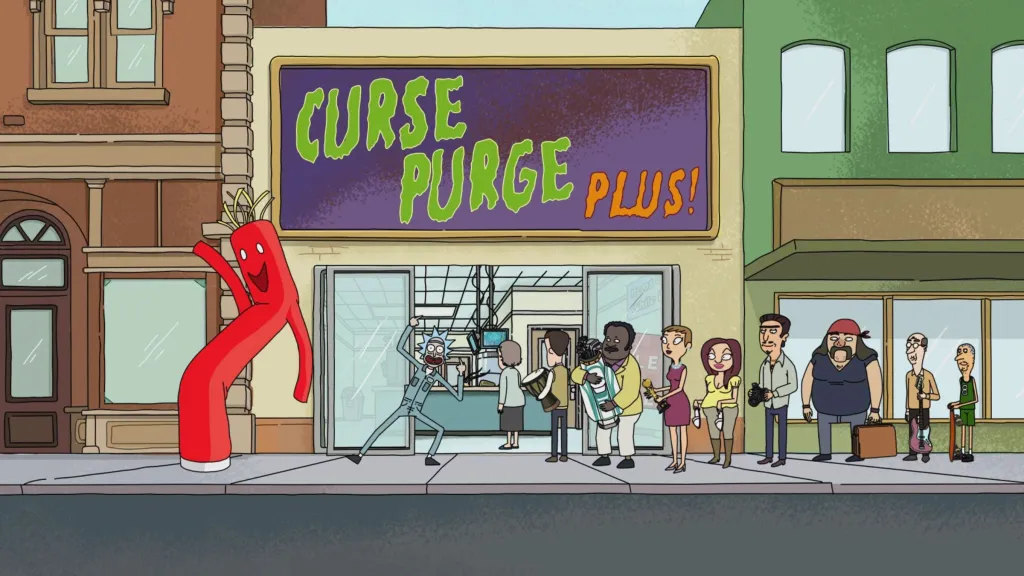
7) Curse Purge Plus!
Image courtesy of Adult Swim
Season 1, Episode 9, “Something Ricked This Way Comes,” is a parody of Stephen King’s Needful Things, centered on a charming shop owner who is literally the Devil and dispenses antiques that fulfill clients’ desires while hiding curses designed to destroy their owners’ lives. When Rick reverse-engineers one of these items, he develops an extraction method capable of scanning any object, identifying its embedded curse, and removing it entirely, then launches Curse Purge Plus! as a direct competitor to the Devil’s shop across the street, offering the service for free. While the idea of measuring evil with technology is intriguing, Curse Purge Plus! also demonstrates that Rick’s scientific genius and his pettiness are functionally inseparable, and one consistently exists in service of the other.
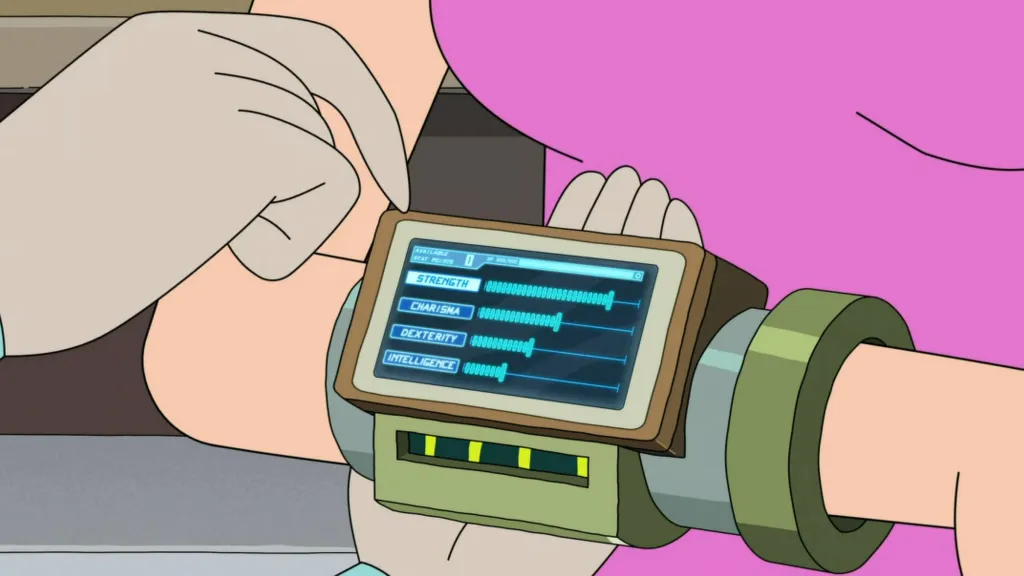
6) The Attribute Slider
Image courtesy of Adult Swim
In Rick and Morty‘s parody of Total Recall, “Wet Kuat Amortican Summer,” introduces a genetic sequencing device that distributes a user’s fundamental traits across a set of adjustable parameters, treating strength, intelligence, dexterity, and charisma as a video game character-creation build menu applied directly to real human biology. Summer uses hers to tilt her stats toward physical and social dominance for a frisbee-golf party, pulling attributes away from intelligence. The Attribute Slider ranks sixth because the episode ultimately plays out its consequences for broad laughs rather than genuinely exploring the horror of dismantling a person’s fundamental composition. When Summer and Morty fuse after misusing the device, the show treats that outcome as a punchline and moves on, leaving the most unsettling implication of the invention unexamined.
5) The Transdimensional Energy Relay
Image courtesy of Adult Swim
The ninth episode of Season 7 of Rick and Morty sends Rick to Valhalla under the cover identity of Odin, where he constructs a technological windmill inside the Norse afterlife to harvest the paradimensional energy that allows the realm to preserve the consciousness of the dead indefinitely. The Transdimensional Energy Relay channels infinite energy back to Rick’s garage on Earth, functioning as a weapons-grade power source that also sends anyone it kills directly to the afterlife as a side effect. The invention works as a comedic premise because it treats the afterlife as simply another exploitable energy infrastructure, entirely consistent with Rick’s worldview that nothing, sacred or otherwise, falls outside the reach of applied science.
4) The Dream Inceptor
Image courtesy of Adult Swim
The second episode of the entire series, “Lawnmower Dog,” runs two simultaneous plots, and its A-story is a direct parody of Christopher Nolan’s Inception and the Nightmare on Elm Street franchise. In the episode, Rick builds the Dream Inceptor as a pair of earpieces: one attaches to a sleeping person, and whoever wears the second piece is pulled into that person’s dream. The rules follow Inception‘s internal logic, where dying inside a dream while using the device results in real-world death and each nested dream layer dilates time by a factor of one hundred relative to the layer above, but the episode strips Nolan’s grandiosity and replaces it with escalating absurdity. The Dream Inceptor establishes, in only the second episode, that Rick and Morty will use science fiction as a structural scaffold to dismantle existing pop culture at high velocity.
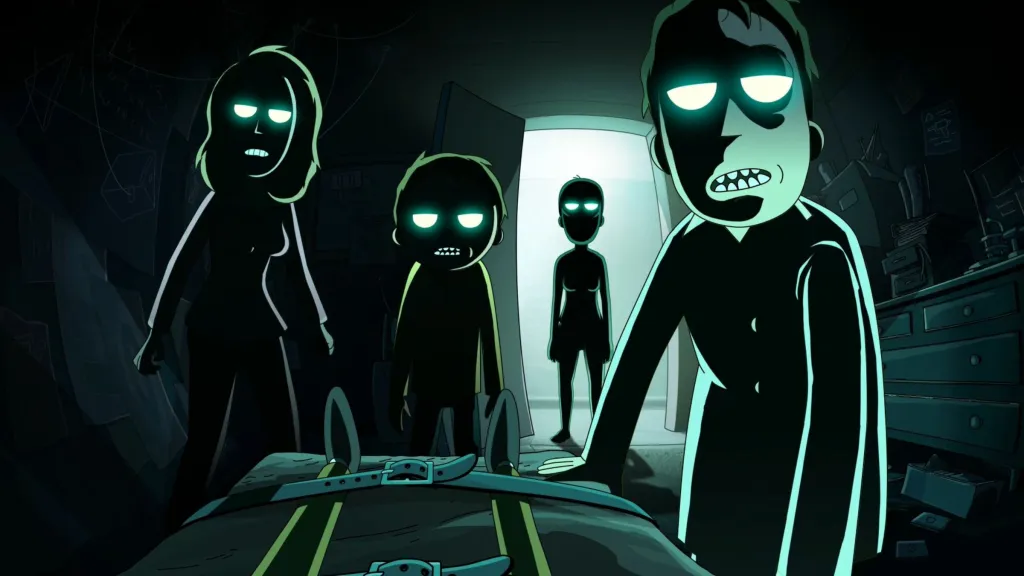
3) The Somnambulator
Image courtesy of Adult Swim
The Somnambulator is a disc-shaped transmitter Rick purchases from the Goobie-Joob system that programs its users’ unconscious bodies to perform pre-assigned tasks during sleep, including building muscle mass and acquiring new languages, while the conscious self wakes with no memory of the activity but retains all the benefits. Of course, the misuse of the technology to enslave the sleeping personas of the Smith family backfires, with the alternate selves rebelling after being pushed too far. While the episode where the Sonambulator appears, “Night Family,” is one of the weakest Season 6 installments, the invention is nevertheless amazing and one of the show’s most memorable pieces of technology.
2) The Save-Point Device
Image courtesy of Adult Swim
The iconic “The Vat of Acid Episode” is the only Rick and Morty episode to win a Primetime Emmy Award for Outstanding Animated Program, and the Save-Point Device is the invention that anchors that achievement. In the episode, Rick builds the gadget at Morty’s request, presenting it as a tool that functions exactly like a video game checkpoint: press the button to lock in your position in time and space, and pressing it again returns you to that saved moment. The actual mechanism is considerably darker, as each activation isolates a moment and shifts Morty into a new, nearly identical alternate dimension where the existing version of Morty is incinerated to make room. Over the episode, Morty uses the device recklessly across dozens of situations, unaware of its functioning, accumulating a trail of dead alternate selves while building a relationship with a woman he loses permanently when Jerry accidentally resets the device.
1) The Microverse Battery
Image courtesy of Adult Swim
Season 2, Episode 6, “The Ricks Must Be Crazy,” centers on the series’ most philosophically audacious invention. The Microverse Battery consists of a spatially tessellated void inside a modified temporal field, which is Rick’s method of generating an entire universe, accelerating it through millions of years of evolution until intelligent life develops, and then presenting that civilization with a kinetic device called the Gooblebox that generates electricity through daily use. Rick siphons the majority of that power to fuel his space cruiser, and the civilization powering it has no idea. The episode’s genius lies in its nested structure, as this advanced civilization also ends up creating its own version of the Microverse Battery, and so on. Each layer mirrors Rick’s own exploitation of intelligent life, a single impossible invention that constructs a recursive moral trap and tightens it with every scene.
Which of Rick’s one-and-done inventions do you consider the most creative single-episode premise in the show’s history? Leave a comment below and join the conversation now in the ComicBook Forum!