Videos by ComicBook.com
For most of its six-decade history, Star Trek lore and canon underwent a slow, incremental change. From The Next Generation building on and perfecting the original formula with a new crew and new adventures, to Deep Space Nine exploring more of the politics of the Federation and intergalactic conflict to Enterprise taking us back to the early days of the Federation and Warp speed travel, each new spin-off brought us something new, but rarely did the franchise rewrite the status quo overnight. However, Star Trek: Starfleet Academy seems to be going warp speed ahead with redefining the political landscape of the Trek Universe.
Just six episodes into its first season, the newest Trek series has already delivered two galaxy-shaping developments, redefining how quickly — and how dramatically — the franchise is willing to change its universe in comparison to previous shows.
Starfleet Academy Introduces a New Center for the Federation
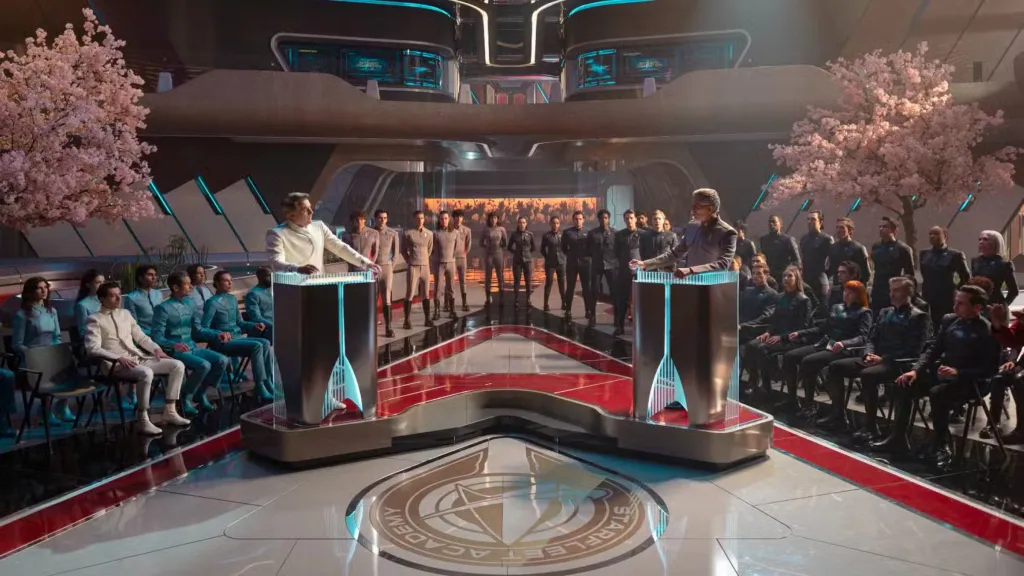
The most immediate change came with the confirmation that the Federation would be formally establishing its new headquarters on Betazed. For longtime fans especially, that is monumental news.
For decades, Earth functioned as the political and symbolic heart of the Federation – partly because, for obvious reasons, it was easier to portray the headquarters on Earth, and partly because, in-universe, humanity was supposedly instrumental in forming the Federation. From The Original Series through The Next Generation, Deep Space Nine and beyond, Starfleet Command and Federation leadership were based in San Francisco. Until the Burn.
As we know, the instantaneous destruction of almost all the dilithium in the Galaxy (which powers warp-speed travel), from the catastrophic event known as the Burn, lead to the near collapse of the Federation. As the ability to travel at faster than light speeds was severely curbed, various planets exited the alliance to protect their own affairs and even Earth eventually seceded from the organisation, meaning the Headquarters of what was left of this once proud force had to be relocated off world.
Once the period of crisis was over, with warp capability slowly being rebuilt, the Federation began to pick up the pieces and rebuild, and it was assumed that headquarters would be moved back to Earth.
Starfleet Academy almost instantly challenged that assumption. The reestablishment of Federation Headquarters, but this time on Betazed, not only sends a clear message that this is a new era for Trek but also signals a deliberate shift away from Earth-centric storytelling. In the post-Burn era, the Federation is rebuilding itself as a truly interstellar alliance rather than, (as has previous been the case), occasionally coming across as a bit of a human-dominated almost colonial force. Choosing Betazed — a world known for its empathic abilities and history of diplomacy – makes more sense than returning to Earth simply out of tradition and reinforces that message.
Betazed suffered enormously during the Dominion War and then again in the wake of the political turmoil caused by the Burn. To protect themselves from the chaos and violent marauders (specifically the Vanari Ral), during the collapse of interstellar safety, the Betazoids used their immense telepathic abilities to erect a “psionic wall” or psychic barrier around their home system. They have every reason to be wary of outsiders, and it was only a new generation of Betazoids more open to reforming diplomatic relations that lead to them finally agree to lower their defences.
Making Betazed the Federation’s new political center, reflects the new era of healing and reinvention that Star Trek seems to be going for. However, in the past, such a monumental decision as a relocation of Federation headquarters would most likely have only occurred in the climax of a season-long storyline.
Here, the concept is explored and established over the course of a single episode and in only the second episode, before the show has even finished introducing its main cast.
Star Trek Now has A New Home for the Klingon Empire

If the Federation’s moving house was surprising, another revelation we received just two episodes later about the Klingons was seismic.
In episode 4 ‘Vox in Excelso’,Starfleet Academy confirmed that Qo’noS, the Klingon home world, had unfortunately not survived the destruction of the Burn, and the remaining Klingon families, all that are left of a once proud empire, were left as refugees, scattered across the Galaxy and searching for a way to rebuild their civilization from near-total collapse.
It was something of a tear-jerking reveal. Though we never saw much of Qo’nos itself on the show, from The Next Generation onward, the Klingon planet was a symbol of their staunch traditions and fierce cultural pride. Even when intergalactic politics were turbulent, and the Klingon Empire was in decline and even through the eventual thawing of relations and Klingon joining of the Federation, their home world remained a constant. The revelation suggested that the Burn and its aftermath were even more devastating than previously understood. The Klingons were not merely weakened — they were devastated by the catastrophe.
Once again, what would once have fuelled almost an entire series arc is dealt with over the course of a single episode when the Klingons refuse to accept the Federations offer of relocation to a new planet that has a similar atmosphere to Qo’nos, out of an arguably misplaced sense of pride. The Federation eventually resort to a genius bit of reverse psychology, claiming they have ‘trespassed’ on Federation space and ‘fighting’ them for the planet, leading to a happy ending for Klingon-kind as they take their new planet as part of the spoils of war.