Here are 7 martial arts movies that did something really memorable but are rarely talked about. You may have heard of them at some point, but they’re hardly ever the ones people bring up when discussing the genre.
7) Kung Fu Hustle
image courtesy of Huayi Brothers
When it comes to martial arts movies, Kung Fu Hustle does tend to come up, but usually in a very specific kind of conversation. It’s a film that’s well known among fans of the genre, yet it rarely shows up in discussions about “serious martial arts cinema.” That’s largely because its humor, exaggerated tone, and almost cartoonish visuals lead many people to dismiss it as a parody, when in reality it’s one of the most informed and self-aware tributes to classic kung fu cinema. It treats martial arts as a cinematic language, not just as spectacle or action for action’s sake.
The story follows a small-time con artist trying to prove himself in an apparently ordinary neighborhood, unaware that several legendary kung fu masters are hiding there. It’s a simple premise, but intentionally so, since the real goal is to play with archetypes, fighting styles, and long-standing myths of the genre (which is exactly why it resonates so strongly with audiences who give it a chance). In short, Kung Fu Hustle isn’t overlooked because it lacks martial arts impact, but because many people still mistake lightness for superficiality.
6) Ong-Bak: The Thai Warrior
image courtesy of Sahamongkol Film International
For a while, among genre fans, Ong-Bak: The Thai Warrior was treated as “the movie that introduced Tony Jaa” — and that was the problem. Over time, the film got stuck with that label, as if it were nothing more than a calling card, when in reality it was a turning point for martial arts cinema in the early 2000s. Outside of action-focused circles, a lot of people simply forgot how much this movie changed the game, especially since it reintroduced raw, physical combat to the mainstream at a moment when action movies were starting to rely heavily on digital tricks and CGI.
The story follows a young Muay Thai fighter who travels to Bangkok to recover a sacred statue stolen from his village. It’s a very straightforward narrative setup, functioning mainly as a clean trigger to keep the character moving, justify constant confrontations, and showcase fighting in increasingly extreme situations. So after Ong-Bak, the genre began to favor cleaner choreography and reduced editing, but it was a shift that ironically worked against the film’s legacy. Today, it’s talked about less, not because it lost relevance, but because its influence was absorbed so quickly that its original impact became normalized.
5) Armour of God
image courtesy of miramax films
Jackie Chan is one of the biggest icons in martial arts cinema, and everyone already knows that. But within his massive filmography, some movies never stood out as much, and Armour of God is one of them. That likely has a lot to do with the fact that the film totally embraces an adventure vibe, mixing action, comedy, and relic-hunting without any hesitation — something that makes certain fans take it less seriously as a “pure” martial arts movie. And when there are more famous and traditional kung fu titles in Chan’s catalog, it’s not surprising that this one often gets overshadowed.
In Armour of God, Chan plays a mercenary caught up in a mission to recover stolen religious artifacts, following a structure clearly inspired by Indiana Jones. Along the way, the movie delivers dangerous stunts, physical comedy, and some of the most impressive displays of Chan’s body control, right at the peak of his career. It’s rarely talked about because, bluntly, it refuses to fit neatly into a single category.
4) SPL: Kill Zone
image courtesy of ABBA Movies Co. Ltd.
SPL: Kill Zone is another movie that’s well known and respected among hardcore fans, but rarely comes up in more mainstream conversations. A big reason for that is that it isn’t “fun” in the traditional sense. It’s a heavy, tense, and emotionally charged film that treats fighting as an extension of the drama rather than a standalone spectacle — which is very different from what most audiences are used to. It knows exactly what it wants to be and executes that vision extremely well, but its darker, more grounded approach makes it easier to overlook.
The story centers on a detective obsessed with taking down a powerful crime boss, even as everything around him begins to fall apart. The fight scenes (especially those involving Donnie Yen) are deliberately dry and grounded, designed to feel closer to real confrontations than polished choreography. The goal isn’t flash, but impact: weight, force, and a constant sense of risk. Because of that, SPL naturally appeals more to dedicated genre fans and struggles to break out of that bubble; it demands more from the viewer and offers very little comfort.
3) Wing Chun
image courtesy of Century Pacific
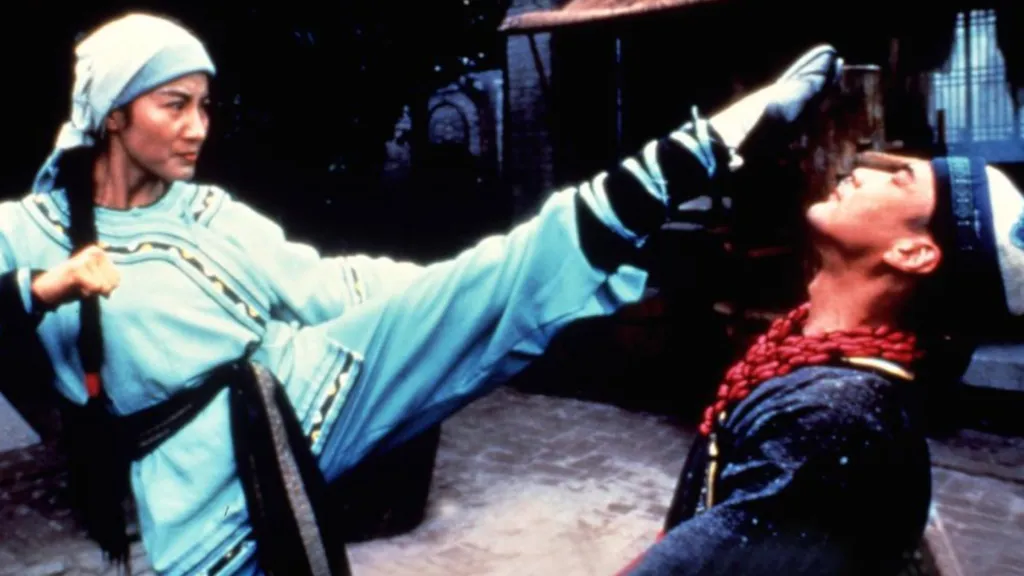
This is a great example of how a movie can have all the right names attached to it and still fail to gain real momentum. Wing Chunstars Michelle Yeoh and Yen, and is directed by the legendary Yuen Woo-ping, which, on paper alone, should guarantee it a constant spot in martial arts discussions. Instead, the film takes a lighter approach, blending romance and comedy into the mix, and as a result, it’s often dismissed as something smaller and less serious than its peers.
Inspired by the legend of the founder of the martial art that shares its name, the story follows a young woman who uses her skills to defend herself and protect her community. The fight scenes are fast, creative, and full of personality, but the movie never tries to feel grand or epic (and that’s where it loses a lot of people). Simply put, Wing Chun doesn’t get talked about much because it doesn’t demand so much attention — but that’s not a flaw; it’s simply not the kind of movie that demands attention to make its point. Massively underrated.
2) Equilibrium
image courtesy of miramax films
When people talk about the genre, it’s easy to focus on Eastern cinema and forget how many other productions were clearly inspired by it. Equilibrium almost never comes up in these conversations, and when it does, it’s rarely labeled as a martial arts movie — which is ironic given how much the film revolves around a very specific combat language. The gun-kata may seem over-the-top or even silly to some viewers, but it’s a deliberate attempt to create an entirely new martial discipline within a sci-fi framework (something very few movies actually try to pull off).
Set in a dystopian future where emotions are outlawed, the story follows a government agent who begins to question the system he’s been enforcing. On paper, the premise is attention-grabbing, and once you watch the film, it becomes clear how intentionally choreographed the action really is: repetitive by design, highly stylized, and pushed to an extreme. That isn’t a flaw, though. Equilibrium establishes its own rules and sticks to them, giving real identity to what could have easily been an empty style. The problem is that it lives in the space between sci-fi and martial arts, and was never fully embraced by either side.
1) Brotherhood of the Wolf
image courtesy of metropolitan filmexport
Almost the ultimate example of an underrated martial arts movie, Brotherhood of the Wolf is completely overlooked for being French, historical, and a genre hybrid. It’s genuinely hard to find people talking about it, even though it features fight scenes that are far more memorable than those in many bigger, more popular productions. On top of that, the film is impressive because it completely breaks the mold of what people expect from the genre, choosing to blend choreographed action with horror, history, and a distinctly European aesthetic. It’s a bold movie that proves martial arts cinema doesn’t have to be boxed in.
Brotherhood of the Wolf draws from real events and folklore to follow investigators sent to hunt a mysterious creature terrorizing a rural region of 18th-century France. And as the story unfolds, it grows increasingly ambitious, weaving in political conspiracy, social commentary, and spectacle. Within that framework, the fight scenes appear almost unexpectedly, but instead of functioning as crowd-pleasers, they’re fully integrated into the world-building and narrative tension. The result is that constant feeling that none of this should work together, yet it absolutely does. It’s another underrated standout because it refuses to fit into a comfortable category, which, in this case, is exactly the point.
Have you ever heard of any of these movies? Leave a comment below and join the conversation now in the ComicBook Forum!