The fixation on those two, however, has obscured a deeper history. Dragons predate both Smaug and Toothless in cinema by decades, and the range of what the creature has represented across fantasy filmmaking is far broader than any single archetype suggests. Medieval Western tradition cast the dragon as the quintessential threat, the fire-breathing obstacle standing between the hero and the prize. East Asian storytelling assigned the creature an entirely different symbolic weight, positioning it as a divine intermediary and a force of fortune rather than destruction. Fantasy cinema has drawn from both traditions, producing dragons that function as con artists, river gods, disgraced ancestors, and digital pioneers.
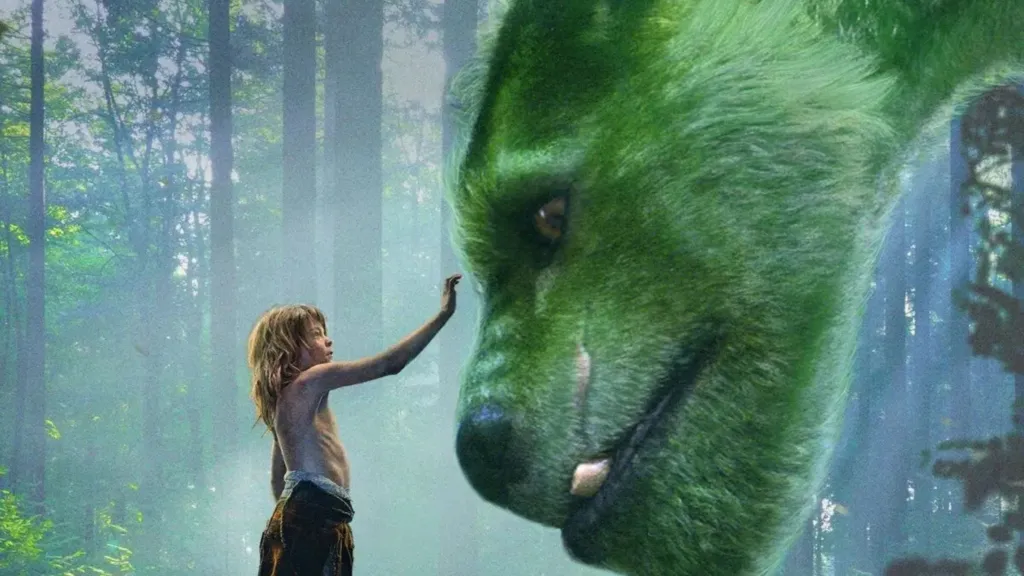
7) Elliot (Pete’s Dragon)
Image courtesy of Walt Disney Pictures
David Lowery’s 2016 remake of Pete’s Dragon made a controversial choice by covering Elliot in green fur rather than scales, a decision driven by the need to make the dragon feel like a genuine companion to a feral child who had known no other family. The visual effect team rendered Elliot with a physicality grounded in the dense Pacific Northwest forest environment, giving the creature real weight and presence as it moved through trees and undergrowth. That tactile quality set Elliot apart from most contemporary CG creatures, which tended toward sleek surfaces that photographed cleanly but rarely felt anchored in their environments. The emotional logic of the design also held, as Elliot’s soft eyes and dog-like proportions communicated warmth rather than menace, which was the entire premise of the film. Pete’s Dragon earned a modest $143 million worldwide and passed through theaters quietly, but the craft behind Elliot’s construction represents some of the best creature work Disney’s live-action division ever produced.
6) Falkor (The Neverending Story)
Images courtesy of Warner Bros. Pictures
Wolfgang Petersen’s 1984 adaptation of The Neverending Story gave audiences a Luckdragon that looked like nothing else fantasy cinema had created at the time. Rather than drawing from Western tradition, the production leaned into the East Asian conception of the dragon as an elongated, benevolent creature, giving Falkor an ivory-scaled body, a warm canine face, and a disposition rooted entirely in optimism. The physical puppet required multiple operators and a fabrication process that pushed the limits of practical effects technology available in early 1980s Germany, and the resulting creation was simultaneously fantastical and approachable. Within The Neverending Story, Falkor functions as the ideological counterweight to The Nothing, a force of goodwill and forward momentum set against the film’s central force of annihilation. That thematic clarity, embodied in a unique creature design, established Falkor as one of the most recognizable fantasy characters in cinema history.
5) Elizabeth (Shrek)
Image courtesy of DreamWorks Animation
DreamWorks built Shrek around the systematic dismantling of fairy tale conventions, and Elizabeth is one of the franchise’s most effective subversions. Introduced as the terrifying guardian of Princess Fiona’s (voiced by Cameron Diaz) tower, she follows the structural blueprint of the medieval castle monster before the film redirects her through an unexpected romantic fixation on Donkey (voiced by Eddie Murphy). The creative decision to give a fire-breathing dragon a jealous streak and a fragile ego produced some of the franchise’s most reliably funny moments, and the animators gave Elizabeth an expressive face capable of communicating wounded pride with genuine comedic precision. Her name appears as a throwaway detail in Shrek 2 and was later confirmed through DreamWorks’ own promotional materials, a quietly mundane touch that fit the franchise’s broader approach of treating mythological figures as ordinary people with ordinary problems.
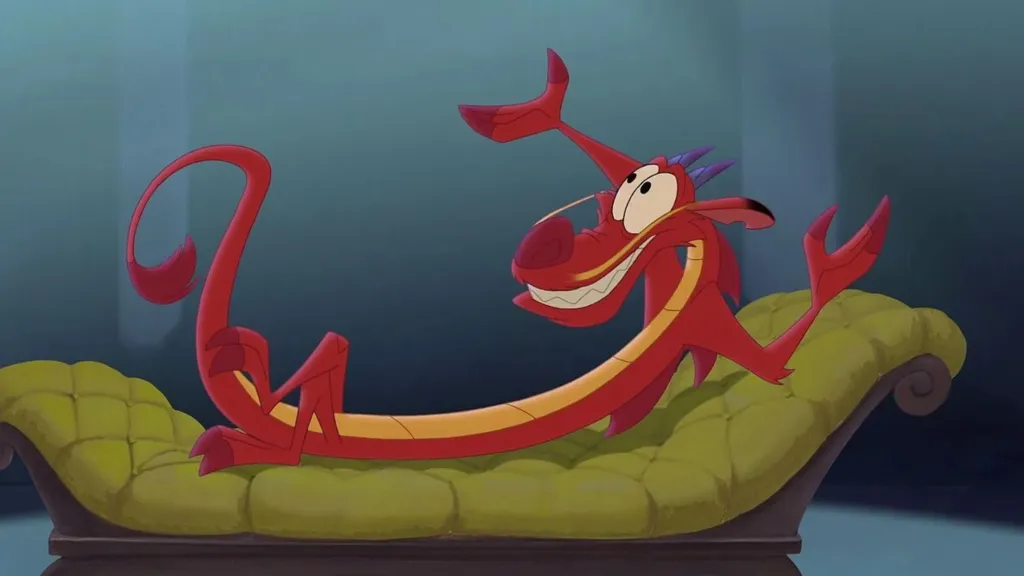
4) Mushu (Mulan)
Image courtesy of Walt Disney Pictures
Disney’s Mulan drew from Chinese mythology for its visual language, with Mushu (voiced by Eddie Murphy) depicted as a miniature red dragon whose diminutive stature deliberately inverts every Western expectation the fantasy genre had established. In Chinese tradition, dragons are divine intermediaries and symbols of imperial authority, not fire-breathing destroyers, and Mulan‘s animators used that cultural framework to build a character whose fragile ego functions as a direct contrast to the grand legacy he claims to represent. Mushu stands barely taller than Mulan’s head, carries a cricket for companionship, and spends most of the film navigating the gap between his self-image and his actual capabilities. The resulting character became one of the most beloved sidekicks of Disney’s Renaissance era and a great example of how mythology can be reinterpreted without losing its essential meaning.
3) The Hungarian Horntail (Harry Potter and the Goblet of Fire)
Image courtesy of Warner Bros. Pictures
Goblet of Fire delivered the Harry Potter franchise’s first genuine large-scale action sequence, and the Hungarian Horntail is the reason it worked. Designed by a creature effects team under supervisor Nick Dudman with a mandate to avoid resembling any existing cinematic dragon, the Horntail emerged as a wyvern-like animal with black scales, bronze horns, and a spiked tail capable of gouging meter-long trenches into stone. Its fire-breathing was also realized through a combination of digital animation and practical flame elements, which helps the dragon to feel alive on screen. The film’s key creative decision was allowing the Horntail to break its chains and pursue Harry across the rooftops of Hogwarts, transforming what the novel staged as a contained arena event into a full aerial chase across the castle grounds. That expansion gave Goblet of Fire a kinetic energy the franchise had not previously attempted, and the Horntail’s relentless pursuit across the stone viaduct before its plunge into the chasm below remains one of the most visceral battles in the entire saga.
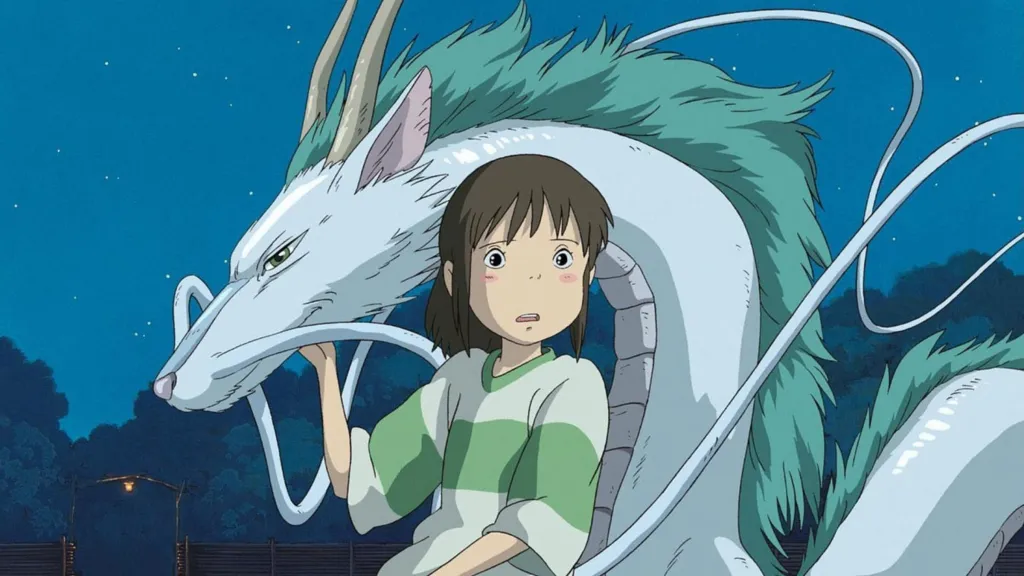
2) Haku (Spirited Away)
Image courtesy of Studio Ghibli
Haku occupies a unique position among fantasy cinema’s dragons because his dragon form is not his primary identity. Introduced as a mysterious boy (voiced by Miyu Irino) who guides the protagonist Chihiro (voiced by Rumi Hiiragi) through the spirit world in Spirited Away, Haku reveals himself as a river spirit capable of transforming into a serpentine dragon modeled on the lung dragons of East Asian tradition. Studio Ghibli’s animation team gave this form a fluid, wave-like movement that distinguished it entirely from the wing-and-fire creatures of Western fantasy, and the design reflects Hayao Miyazaki’s consistent interest in depicting the natural world as a domain of genuine spiritual power. Haku’s amnesia, the emotional driver of his arc, reinforces Spirited Away‘s central argument about the erasure of memory and identity, giving his dragon form a narrative function that extends well beyond visual spectacle. The film won the Academy Award for Best Animated Feature in 2003 and remains the only non-English-language animated film to claim that distinction, with Haku’s dragon form standing as one of the most visually striking images in the medium.
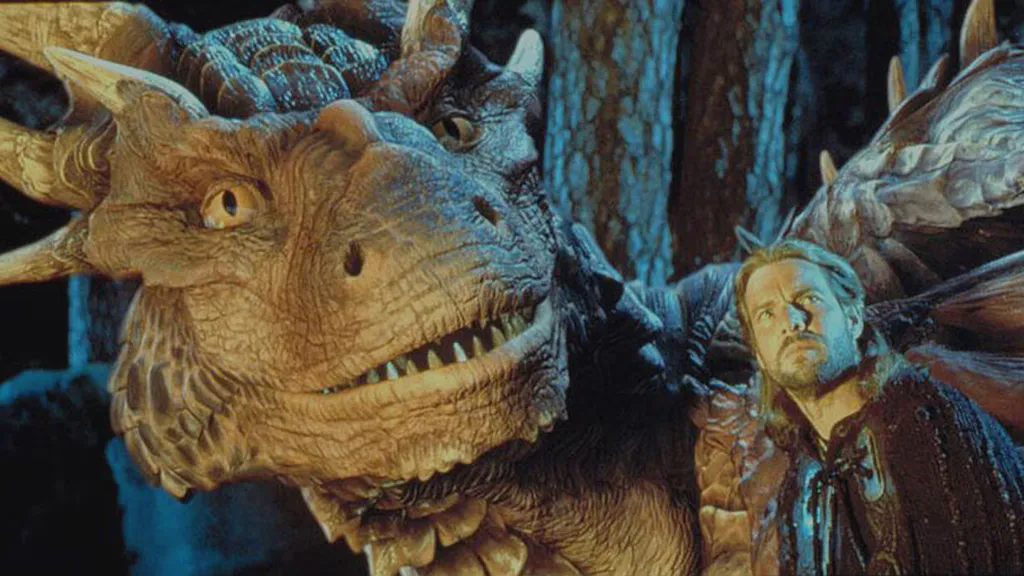
1) Draco (Dragonheart)
Image courtesy of Universal Pictures
Dragonheart arrived in 1996 as a genuine technological landmark: Draco (voiced by Sean Connery) was the first fully computer-generated leading character in a major Hollywood feature, a distinction that placed an enormous burden on Industrial Light & Magic to deliver a performance-capable digital creature at a time when the technology had only just proven itself through the morphing sequences of Terminator 2. Director Rob Cohen built the entire narrative around Draco’s partnership with the dragonslayer Bowen (Dennis Quaid), a relationship that begins as a con artist scheme before deepening into one of fantasy cinema’s most unexpectedly affecting friendships. Connery’s voice gave Draco a sardonic gravitas that no other dragon in the genre has replicated, transforming a computer-generated model into a character whose death in the final act earned its emotional weight through performance rather than spectacle. Dragonheart grossed $115 million worldwide against a $57 million production budget, a modest commercial outcome that understated the film’s lasting influence. Every photorealistic CG creature that followed traces a direct line back to the choices ILM made in bringing Draco to life.
Which dragon from fantasy cinema do you consider the most memorable of all time? Leave a comment below and join the conversation now in the ComicBook Forum!