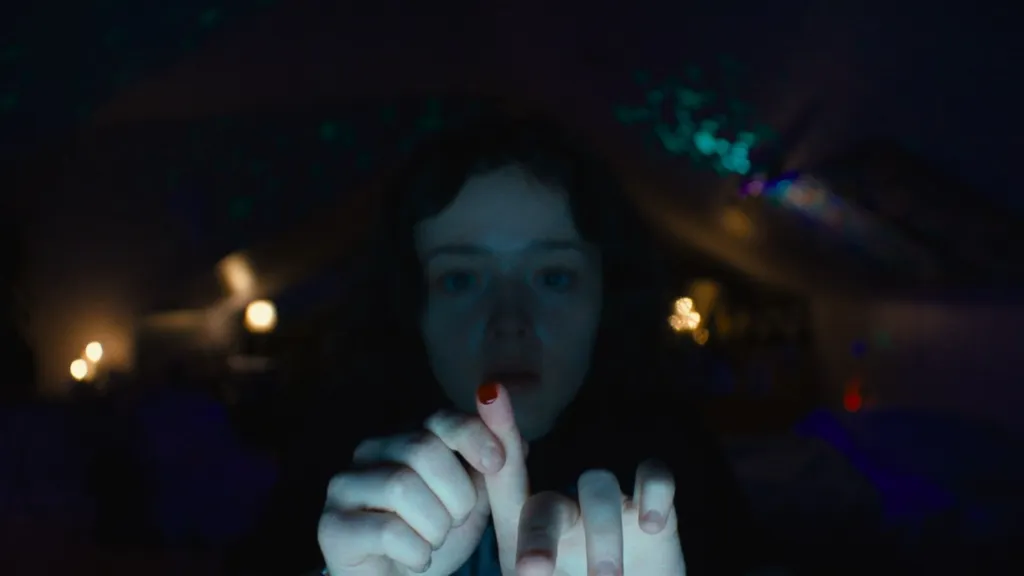
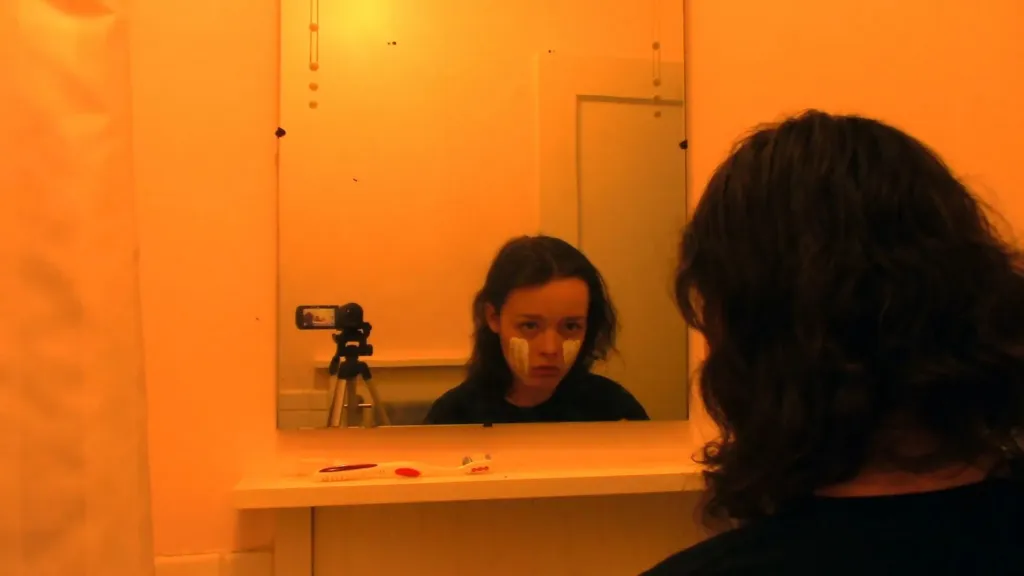
We’re All Going to the World’s Fair centers on Casey (Anna Cobb), a teenage girl who sits alone in her attic bedroom and records herself taking the titular “World’s Fair Challenge,” a fictional online ritual drawn from the creepypasta culture. She then begins documenting the changes it allegedly causes her, posting the footage into the void while receiving a series of messages from a mysterious figure named JLB (Michael J. Rogers). Shot on digital video with a deliberately low-fi aesthetic, the film premiered in the Next section at the 2021 Sundance Film Festival before receiving a limited theatrical release from distributor Utopia. On Rotten Tomatoes, We’re All Going to the World’s Fair holds a 91% approval rating from 124 critics. The audience score, however, is currently only 28%.
What Critics Think of We’re All Going to the World’s Fair
Image courtesy of Utopia
The positive critical response to We’re All Going to the World’s Fair is based on the recognition that Schoenbrun built a film that understands creepypasta not as a collection of internet ghost stories, but as a social architecture. The World’s Fair Challenge works within the film as a stand-in for the broader phenomenon of online identity performance, where anonymous users adopt elaborate personas as a way of processing emotions that conventional social structures refuse to accommodate. Casey uses the challenge as a framework through which to construct a self, documenting a transformation that may or may not be real but serves a genuine psychological function regardless of its veracity.
The critical consensus on Rotten Tomatoes describes the film as “narratively challenging and visually haunting,” and both adjectives are accurate in ways that illuminate why the work resonated with professional reviewers. Schoenbrun, who drew directly from personal experiences with fanfiction sites and internet forums as a teenager, constructed a portrait of adolescent loneliness that treats digital spaces with genuine anthropological curiosity. The score by musician Alex G reinforces this approach, using ambient sounds that feel native to the bedroom-computer aesthetic rather than imposed upon it. In addition, the low-resolution camerawork, which Schoenbrun shot to replicate the visual texture of early-2000s internet footage, collapses the distance between the viewer and the screen where Casey is searching for herself.
Why We’re All Going to the World’s Fair Got a Harsher Reception From Horror Fans
Image courtesy of Utopia
The fundamental problem with the We’re All Going to the World’s Fair‘s commercial release was the decision to heavily market it as horror, a classification that sent the wrong audience into the theater. Horror audiences frequently expect movies that have escalating dread, payoffs to established setups, and at least some attempt to produce fear as a direct emotional response. We’re All Going to the World’s Fair does none of those things. Its runtime of 86 minutes is structured around quiet stretches of Casey staring at a screen or walking through an empty rural landscape. Schoenbrun builds a sense of accumulating unease, but that unease is designed to generate discomfort rather than fright, and the distinction matters enormously in terms of audience experience.
Multiple user reviews on IMDb and Rotten Tomatoes point to the same source of frustration, and they are not wrong on factual grounds. One recurring complaint describes the film as a “bait and switch,” and that criticism lands because the marketing material, the Sundance positioning, and the genre label all primed viewers for a supernatural story the film never intended to provide. Schoenbrun’s actual subject is the way creepypasta functions as an escape mechanism for teenagers who feel invisible in their offline lives, as Casey participates in the World’s Fair Challenge because it gives her a community and a reason to document her own existence. The horror iconography that derives from creepypasta is the delivery system of this character study, not the goal of the movie itself.
We’re All Going to the World’s Fair belongs in the horror genre due to its themes, but even people who enjoyed the experience—this writer included—have to admit the movie refuses to operate as a horror film in functional terms. Creepypasta emerged from the same cultural impulse that produced campfire stories, as the use of supernatural threat often helps humans to examine anxieties that are difficult to articulate directly. We’re All Going to the World’s Fair understands that lineage and works within it. However, while the film’s discomfort is real, it comes from watching a teenager use fictional transformation as a substitute for addressing genuine psychological pain, without jump scares or a frightening storyline. An audience that arrives expecting horror in a traditional sense and receives something closer to an experimental coming-of-age study has every reason to feel misled, which helps to explain the disconnect between critics and audience members in this case.
We’re All Going to the World’s Fair is currently available to stream on the Criterion Collection, Hoopla, and Kanopy.
What did you think of We’re All Going to the World’s Fair? Leave a comment below and join the conversation now in the ComicBook Forum!