Videos by ComicBook.com
In 1983, the late comic book artist Bernie Wrightson released a pen-and-ink adaptation of Mary Shelley’s Frankenstein, which is often considered the definitive illustrated edition of the tale. The resemblance between Wrightson’s illustrations and the film’s imagery is undeniable. Even del Toro himself has said the artist’s work was foundational. The direct contribution in the film’s credits reads: “Frankenstein character design inspired in part by Bernie Wrightson’s ‘Frankenstein monster.’” For Frankenstein and del Toro fans alike, Wrightson’s elaborate, detailed vision is something to behold.
Bernie Wrightson’s Frankenstein
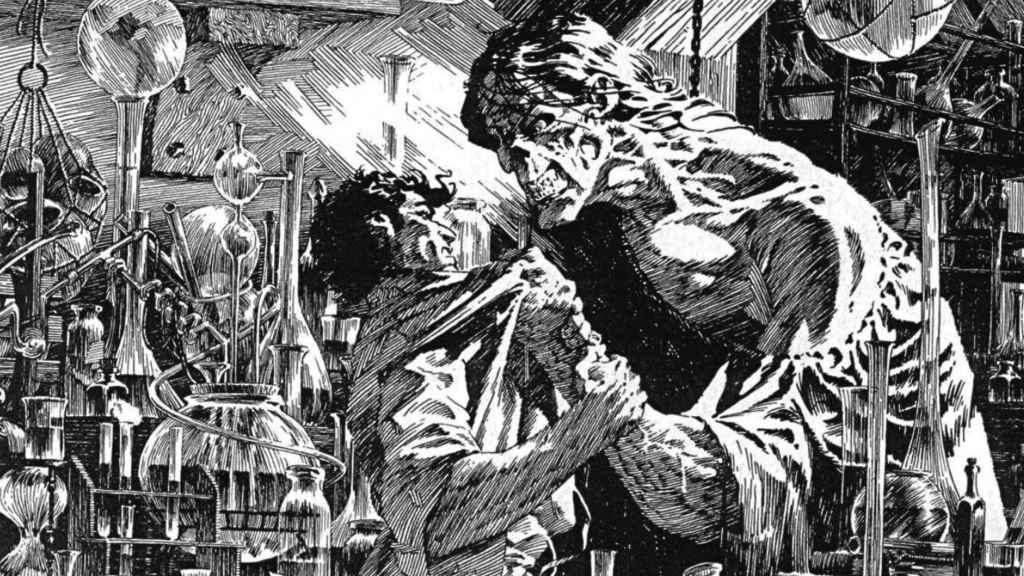
Before his death in 2017, Wrightson had secured his place among the comic book legends. Between his 1971 co-creation of Swamp Thing with Len Wein and his illustrations for Stephen King’s Cycle of the Werewolf, Wrightson built a reputation as a horror visionary. Yet it was after adapting other Gothic stories by Edgar Allen Poe and H.P. Lovecraft that Wrightson began an unpaid passion project, spending seven years hand-illustrating his own edition of Frankenstein. The result was a book of 45 astonishing black-and-white illustrations rendered in his distinct crosshatching technique.
The book was initially published by Marvel Comics in 1983. It was also explicitly based on Shelley’s descriptions, avoiding influence from the existing film adaptations at the time. Wrightson’s monster was a gaunt, wide-eyed, pale creature, clad in military clothing, and he was more human than the version the public had come to know. This approach is echoed in del Toro’s Frankenstein, and in many ways, Wrightson is the main link between Shelley’s novel and the recent film.