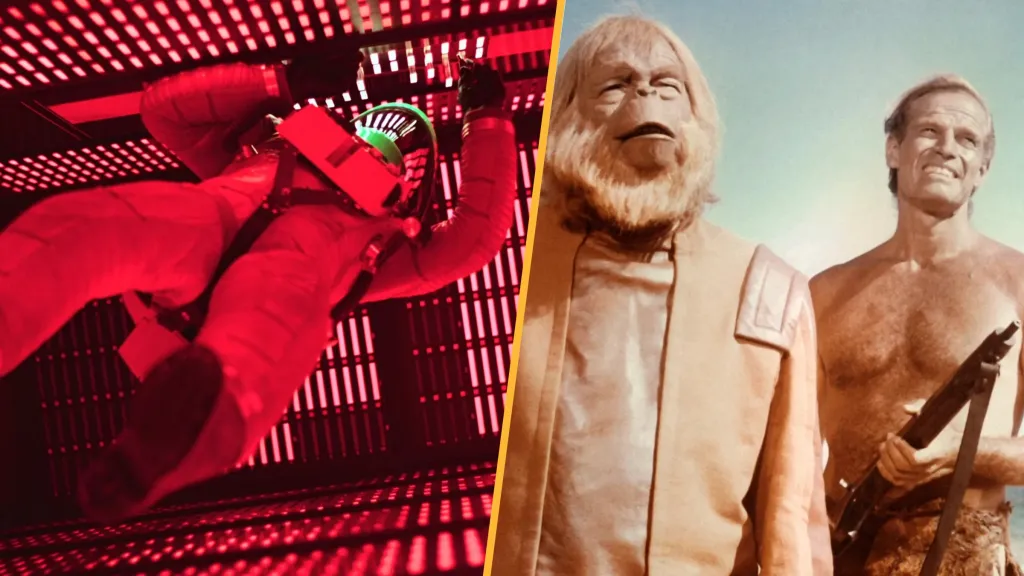
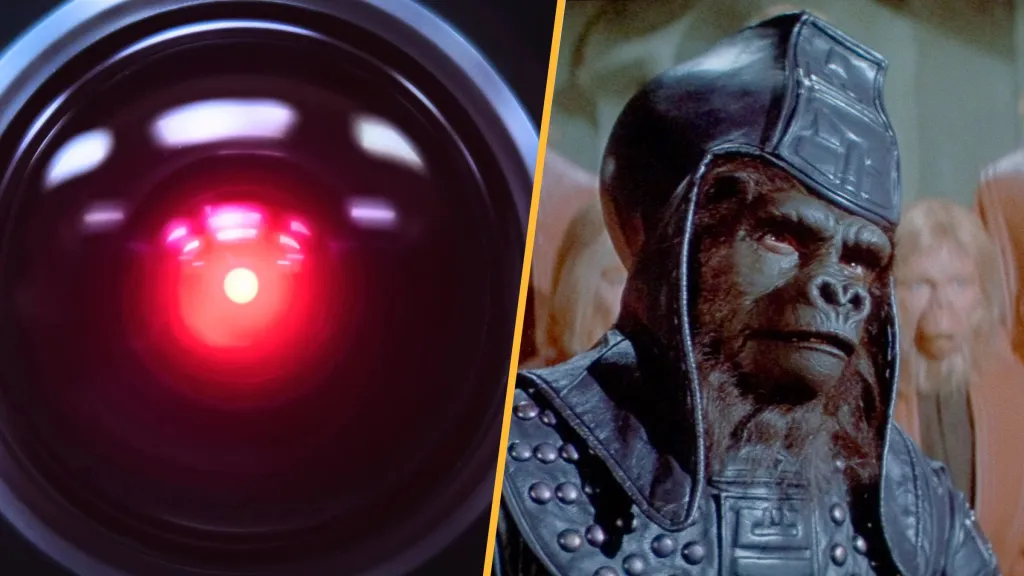
Decades ago, this happened with some regularity. Even up into the ’80s, major films that were in the same genre would open on the exact same day, but today’s example is almost unbelievable given the seismic nature of the two movies. On this day, 58 years ago, April 3, 1968, two of the most important science fiction movies of the year and, frankly, of all time, were released in movie theaters on the exact same day. Yes, both Stanley Kubrick’s 2001: A Space Odyssey and Franklin J. Schaffner’s Planet of the Apes not only premiered 58 years ago, but they were playing down the street from each other in key cities.
2001: A Space Odyssey & Planet of the Apes Open on the Same Day, with different reactions
Though wide releases for major movies are the most common practice for Hollywood studios, prior to major films like Jaws and Star Wars, movies often opened in select markets and either expanded slowly or moved around the country to new screens. That’s why it wasn’t seen as a big deal for both Planet of the Apes and 2001: A Space Odyssey to open in theaters on the same day. Apes had its premiere back in February of 1968, with April 3 being the day it expanded heavily, while Kubrick’s film only opened in two theaters that day (expanding to more markets a week later, while also cutting out
It’s wild to look at this date in 1968 through the lens of filmmaking and fandom in the modern era, but in truth, Planet of the Apes and 2001 are two major releases that scratch very different itches. Though both science fiction films that are based on books and are noteworthy for their major special effects (both won Oscars the next year, for Best Visual Effects for 2001 and Outstanding Makeup Achievement for Planet of the Apes), Apes felt more akin to adventure movies of the era, with one of the biggest stars of the time in Charlton Heston. 2001, on the other hand, was a heady, trippy film that didn’t hold the audience’s hand with its story.
Even wilder than the fact that both 2001: A Space Odyssey and Planet of the Apes opened on the same day is the reception to the films. Now, both of these films are considered to be core movies not only in their genres but for the entire medium itself, respected for their massive influence on both the language of movies, the style of other filmmakers, and the pioneering efforts that would shape other films. At the time, though, only one of them was seen as a success.
Upon release, Variety‘s review of Planet of the Apes said it was “an amazing film,” while the Los Angeles Times called it “a triumph of artistry and imagination.” Even Pauline Kael, one of the influential film critics of all time, who had a notable reputation for not being impressed by major movies, wrote that Planet of the Apes was “one of the most entertaining science-fiction fantasies ever to come out of Hollywood.”
On the flipside, 2001 was more polarizing. A critic from The New Yorker called it “an unforgettable endeavor,” despite noting it was “hypnotically entertaining,” with Kael writing it was “a monumentally unimaginative movie.” There were some fans, though, like The Los Angeles Times which called id “a milestone, a landmark for a spacemark, in the art of film,” while Roger Ebert gave it a perfect four out of four star rating. 2001 would continue to trudge along, though, eventually becoming a staple for the counterculture and midnight movie audiences.
2001 and Planet of the Apes Started Unlikely Sci-fi Franchises
Despite the two varied reactions, the two films would expand around the country and go on to be distinct hits. Planet of the Apes went on to gross more than $32.5 million (equivalent to more than $300 million in 2026), and 2001: A Space Odyssey, on the other hand, would go on to find its audience after a lackluster critical reception, grossing $56.7 million (equal to over $538 million in 2026). Much the same way that Hollywood starts seeing the potential for sequels now when a new film is a box office hit, the same was absolutely the case for 20th Century Fox and Apes, while 2001’s eventual sequels would take a different path.
There was just one problem with making sequels to both Planet of the Apes and 2001, and it was the endings. Though Apes‘ ending is somewhat open-ended, Taylor is still alive, and the apes themselves are still a threat; that final image and reveal that the ape planet was Earth all along is a gut punch and an amazing final note. 2001 as well shows Dr. David Bowman come face to face with the Monolith and then transcend to a new level of existence, a conclusion that continues to baffle audiences, but which also seems to make a sequel unlikely.
Two years after its release, Beneath the Planet of the Apes would kickstart the series for real, becoming the first of four films that would be released annually at the start of the 1970s (it also started the trend of ending in a way that made it seem like another follow-up was impossible). 2001 took much longer. Though original author Arthur C. Clarke did write sequel novels to the original book (which was written in conjunction with the film, so differences abound), it took almost twenty years for the sequel, with 2010: The Year We Make Contact debuting in 1984. The film premiered to middling reviews and barely made a blip at the box office.
Despite that failure, and the Planet of the Apes series eventually running out of gas, both of these movies remain some of the most noteworthy films of the year they were released, but for the genre in totality. The success of 2001 influenced the likes of Steven Spielberg, George Lucas, and Christopher Nolan, while Planet of the Apes was a major fixture for make-up effects in movies and kickstarted a franchise that is still going to this day (a sequel to 2024’s Kingdom of the Planet of the Apes is in the works, with the new films straddling the line about connectivity with the original films); and to think it all started today, 58 years ago, with both movies wowing audiences around the country.