That is where the story of Ripley should have ended, but we got Alien: Resurrection anyway. And that might have been okay if the film stuck its ambitious landing…but it didn’t.
What Was Alien: Resurrection Going for and Why Did It Fail?
image courtesy of 20th century studios
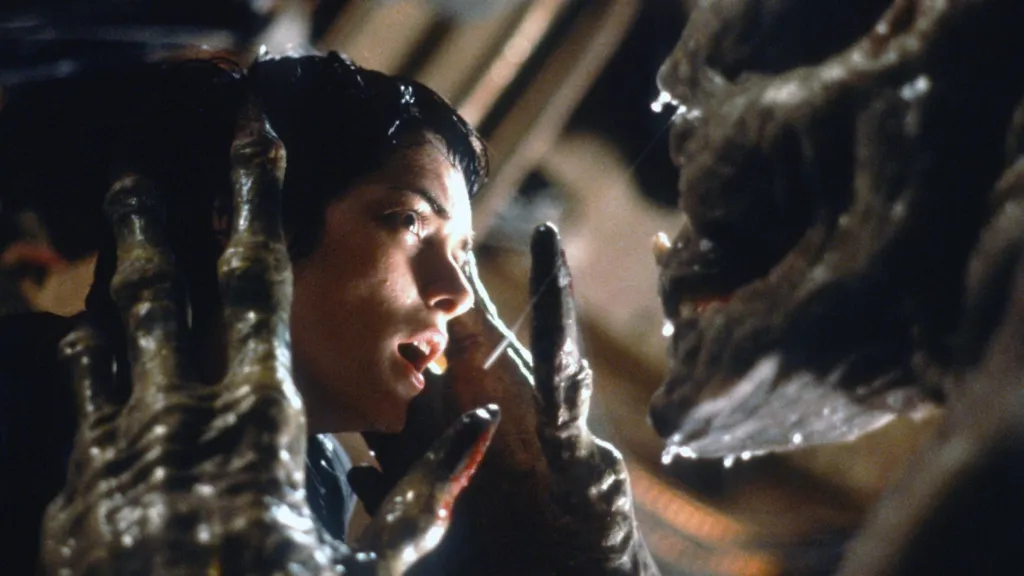
Alien: Resurrection tries to tackle two very interesting themes. One is the Auton, Annalee Call (Winona Ryder). Like Ian Holm’s Ash and Lance Henriksen’s Bishop, she’s a synthetic, but a more advanced one. The Autons ended up rebelling against their flesh-and-blood creators, which led to synthetics being outlawed. To avoid being hunted down and destroyed, Call pretended to be human and hopped aboard the Betty.
That’s all an interesting spin on the synth characters, but the movie glosses over it. It feels as though it needs to deliver on Ripley’s resurrection, considering Sigourney Weaver is the star of the franchise, but by doing so it glosses over the film’s most interesting character.
Furthermore, we don’t get the best sense in the world of why Call is dead set on killing Ripley 8 (as she’s the eighth attempt, but we’ll just refer to her as Ripley from here on out). We understand that Call wants to kill Ripley to stop the Xenomorph Queen from hatching, and that it’s her core programming, but her doggedly attempting to finish a mission counters the most interesting aspect of Call, which is that she essentially hovers in this area between the mission-oriented nature of Ash and Bishop and the full autonomy of being a flesh-and-blood human.
But Call’s character not landing as well as she should is a minor gripe compared to the film’s swing-and-a-miss tackling of the ethics of cloning. There’s a touching scene of Ripley burning up the previous attempts to bring her Xeno-hunting self back to life, but that’s about it. Then there’s the general cost of going the cloning route. In Resurrection, we got Sigourney Weaver back, but we didn’t get the real Ripley back. Weaver is intentionally playing the character as dry with the occasional hints of inquisitiveness, but the result is someone who doesn’t really stand out as interesting, which is problematic when she’s the protagonist.
Then there’s the Newborn-focused third act. Like the Offspring in Alien: Romulus, it’s an ugly creature, but its introduction feels like too much of a hard left turn to gel with the rest of the movie. It also ends the movie on a too-sad note, as it has enough characteristic of a real human baby that it’s unsettling to watch it get its internal organs sucked out its back as it’s yanked up to a hole in the ship’s hull.
Then there’s the design of the Newborn. The idea was to merge Xenomorph DNA and human DNA, and technically Amalgamated Dynamics Incorporated accomplished the task they were assigned, it’s just that the task wasn’t one that should have been pursued to begin with. The Newborn is definitely supposed to be scary, but its expressive humanoid face is just silly. Even after it turns Brad Dourif’s head into a soup bowl, we don’t find it nearly as threatening as the standard Xenomorph.
All due credit to Alien: Resurrection for its attempt to shake things up, but even when it’s just trying to be fast-paced actioner film (which is most of the time) it doesn’t feel like a true Alien movie. You could replace the Xenomorph with a slightly similar creature and never know it was ever supposed to be a member of the overarching franchise. Alien 3 may catch a lot of flack, but it’s solid compared to Resurrection.
Alien: Resurrection hit theaters on November 26, 1997. Will you be giving it an anniversary rewatch tonight? Let us know in the comments.