Videos by ComicBook.com
That is why the tabletop RPG Demeo feels so easy to overlook yet so important to this conversation once you actually play it. It does not scream for attention with flashy hooks or bombastic marketing. Instead, it quietly delivers one of the most thoughtful RPG experiences in VR, one that feels less like a novelty and more like a genuine evolution of how tabletop roleplaying can exist online. If VR has a future beyond quick hits and short sessions, Demeo makes a strong case that this is what it looks like.
How Demeo Brings Classic Tabletop Strategy to Life in a VR World

At its core, Demeo understands what makes tabletop RPGs compelling. It is not just rolling dice or moving miniatures around a flat board. It is the concept of playing in a shared space, the sense of presence, and the feeling that every decision matters because you are committing to it in front of other people.
Demeo recreates that feeling better than almost any digital RPG by turning the table itself into the star of the show. Players gather around a fully realized board, lean in to inspect the dungeon, physically reach out to move pieces, and communicate naturally through gesture and proximity. This simple shift does something powerful. It restores the social texture that most online RPGs lose the moment they move to a flat screen.

Strategically, the game is deceptively deep. Each class has clear strengths, weaknesses, and synergies, and success depends on coordination rather than individual heroics. Positioning matters. Resource management matters. A careless move can spiral into disaster in ways that feel earned rather than cheap. That mirrors the best tabletop experiences, where victory comes from planning together and adapting when things inevitably go wrong.
What makes this especially impressive is how naturally Demeo translates complex systems into VR. Instead of burying players in menus, it relies on physical interaction and spatial awareness for its most prominent features. Cards are drawn, inspected, and played like real objects. Dice rolls feel ceremonial rather than abstract. The result is a game that feels tactile and intuitive, even when the underlying mechanics are doing a lot of heavy lifting.
Why This VR RPG Offers An Experience Unlike Any Other
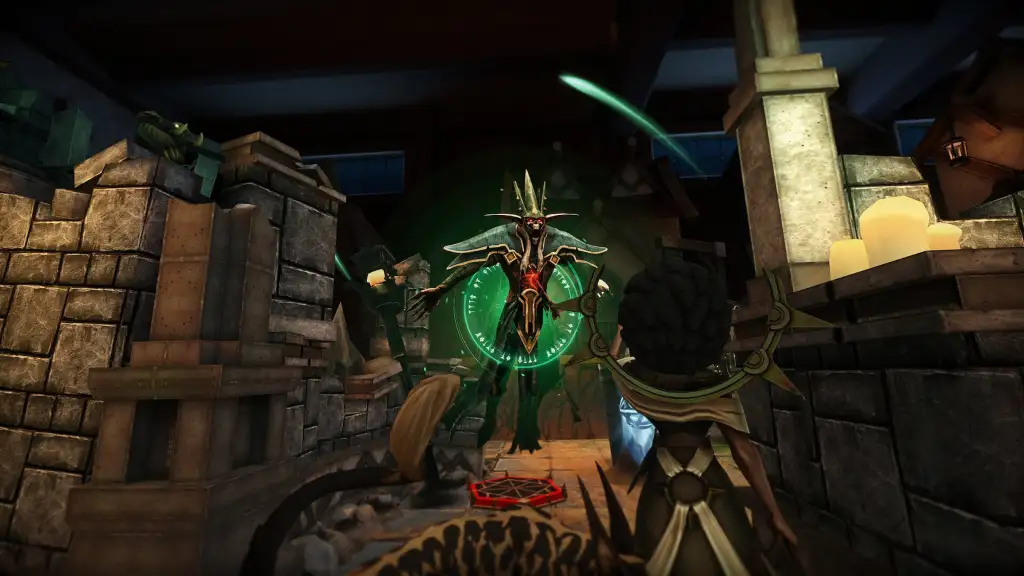
What truly sets Demeo apart is how it reframes online tabletop play. Instead of feeling like a substitute for an in-person session, it feels like a genuine evolution of the format. Players are not multitasking between windows or struggling to stay engaged through voice chat alone. They are present together in a shared environment that encourages attention and interaction.
That sense of presence changes player behavior. Communication becomes more natural, and reactions feel immediate and real-time. In conjunction with this, small physical gestures add emotional texture to every encounter. Victory feels communal, failure feels shared, and both outcomes stick with players in ways that digital RPGs will never be able to achieve. Tabletop is as much a genre of RPG as any other, and these things are what make it up its existence in the space.