Videos by ComicBook.com
To call LaserDisc games innovative doesn’t come close to describing their capabilities. Using a LaserDisc in this manner proved revolutionary, and several outstanding games followed, including Dragon’s Lair, Space Ace, and Mad Dog McCree, to name a few. These functioned as interactive movies, where a player input controls at specific points, often indicated by a highlighted object, which triggered a specific clip. These came with almost no delay whatsoever, and LaserDisc games appeared to be the next wave in arcade gaming. Despite this, the concept fizzled out after some daring innovations, and it disappeared.
LaserDisc Games Nearly Took Over the Industry
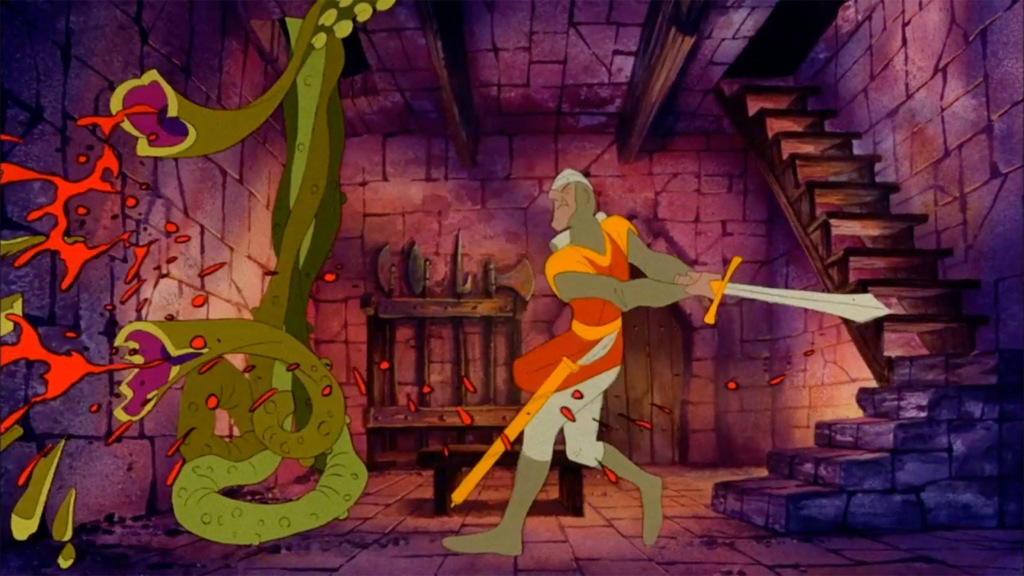
When arcades started offering games like Space Invaders and Pac-Man, few could have imagined that, only a few years later, they’d be playing interactive movies. Still, that’s what happened, and the novelty of these games’ design made them incredibly popular. There’s a scene in Stranger Things Season 2, where the kids scrounge for quarters to go to their local arcade to play Dragon’s Lair, which is how I remember the ’80s. It was the first game to cost two quarters, and while it’s incredibly difficult, it’s also a blast to play. It also didn’t hurt that legendary animator Don Bluth animated the game’s film.
More games followed, including Space Ace, which Don Bluth also animated, and these were ported to numerous systems in the years that followed. Other notable titles include Firefox, Cliffhanger, Cube Quest, Cobra Command, and many more. Sega continued innovating with its LaserDisc games when it released Time Traveler in 1991, the first arcade cabinet billed as a holographic one. It displayed an image above a flat, black glass that appeared to be a proper hologram, and because it was derived via full-motion video on a LaserDisc, it looked amazing. That said, the game wasn’t great, but as a concept, it was innovative.