Videos by ComicBook.com
Mortal Kombat 1‘s Online Options Were Always Lackluster

Online multiplayer is particularly important for fighting games, and this was one of Mortal Kombat 1’s greatest weaknesses. Not only did it take months to eventually get cross-platform play and online practice — industry standard features most titles launch with — it never received online lobbies. Queuing for a match was also particularly annoying because it lacked any way to practice while waiting, meaning players couldn’t stay warm between sets. Anyone who has played MK1 online has spent far too much time looking at trees and that one dragon statue when they could have been practicing combos. Being able to mute players on console and filter for connection types weren’t there at launch. And, to top it all off, the mysterious Warrior Shrine tab in the online menu that was grayed out for more than a year ended up just being a simple and underwhelming seasonal leaderboard.
The netcode is solid, but MK1’s online multiplayer was woefully lacking and took months to get to a somewhat passable (at best) state. 2XKO, on the other hand, is much more fully featured. Cross-play is seamless and supported by an avatar-led lobby system that’s meant to be a digital simulacrum of the bygone era of arcades. Street Fighter 6’s Battle Hub is a more fully featured version of the same idea, but what’s here is more than functional since it allows for quick matches while also getting at the communal aspect fighting games need to thrive.
It is annoying to have to physically run to an arcade cabinet after it finds a match — one button should teleport players to it — and it would be great if players could opt out of the lobby system altogether, so this isn’t a perfect system. It’s possible to practice while searching for matches, but it’s only enabled in ranked mode for some reason and doesn’t kick the player back to practice once the set ends. There also no online practice mode or ping filter. Despite this quibbles, the foundation is solid enough and leaves plenty of room for Riot to build on it in the future. The key here, though, is it isn’t working from the sorely incompetent levels that MK1 launched at.
2XKO‘s Training Options Are Incredibly Robust
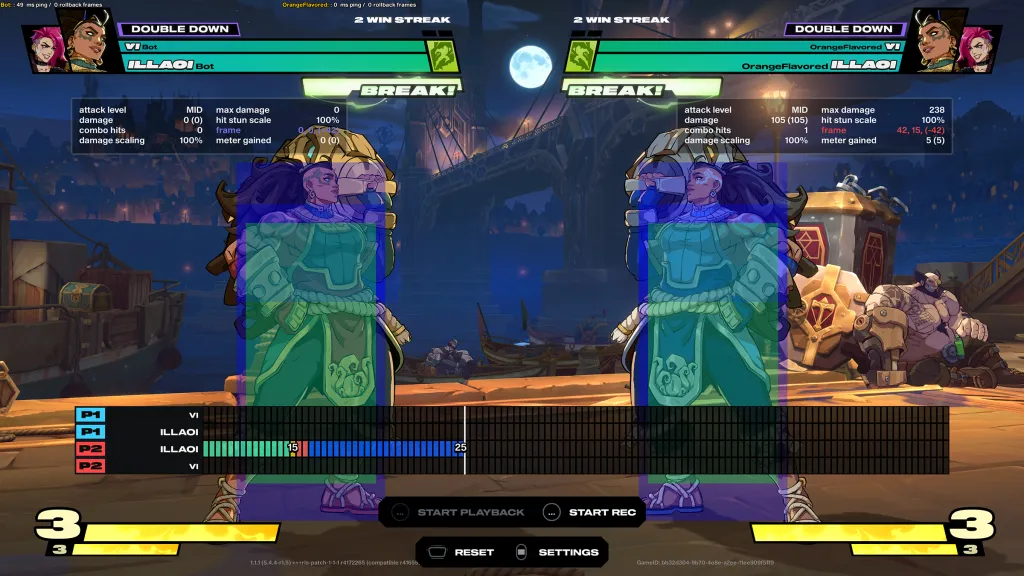
Practice mode is also incredibly robust no matter if players are jumping into it from the main menu or ranked queue. There are a dizzying amount of options here to toggle and move around, meaning those who want to dig into the nitty gritty are more than able to. This means players can slow down the game speed to better understand combo routes, turn on frame data, make the hitboxes and hurtboxes visible, and set exactly what frame the CPU guards on, to name a few.
While it lacks a replay takeover feature (although Riot is aware of the demand), it’s empowering to have such access to so many knobs and switches. MK1’s practice mode was functional for some of the basics, but was lackluster when compared to its peers and even past NetherRealm games; it wasn’t even possible to pin moves on the screen at launch. NetherRealm added character-specific options to practice mode, the ability to pin moves, and, surprisingly, a replay takeover feature, but the mode as a whole was still severely behind the times and is still one of the game’s more underwhelming aspects. NetherRealm was a big pioneer in fighting game tutorials with its character-specific trials (which aren’t even in MK1) and detailed mechanical guides, so it was a huge bummer to see the team fall short of the genre standards as well as its own. Being able to delve into the systems helps newcomers and the hardcore alike in their own different ways, meaning this pain was widespread.