Videos by ComicBook.com
The best X-Men writers have to perform a delicate balancing act. The X-Men rose to prominence because of the way writers were able to balance the soap opera dynamics of the team with wild action and adventure stories. These writers understand how to use the dynamics of the X-Men in perfect ways, giving readers multi-faceted masterpieces. These 10 X-Men writers are the best of the bunch, creating stories that are everything the X-Men should be.
10) Stan Lee/Jack Kirby

I know what you’re thinking — everyone knows that Stan Lee was the writer and Jack Kirby was the artist. However, because of the Marvel Method — which saw the writer and artist plot the book, then the artist drawing the story completely on their own, coming up with the imagery without a script, and then the writer come back in and add the dialogue — it’s impossible to call Lee the writer, as Kirby did even more work of creating the story than Lee did; beyond that, the entire idea of mutants and human evolution is much more of a Kirby idea than Lee’s. Lee and Kirby worked together on X-Men (Vol. 1) #1-17, with Jay Gavin coming in to help with art for X-Men (Vol. 1) #14-17. Kirby and Lee worked created the bedrock of the X-Men, introducing villains like Magneto, Mastermind, the Blob, Scarlet Witch, Quicksilver, the Juggernaut, and the Sentinels. Lee and Kirby always made a good team, and their time on the X-Men was fruitful.
9) Roy Thomas

Roy Thomas was Stan Lee’s heir apparent (Jack Kirby made a character called House Roy to work with his Stan Lee pastiche Funky Flashman in his New Gods books at DC) and is one of Marvel’s most legendary creators. Thomas is most well-known for his work on Avengers and Conan the Barbarian, but he wrote a lot of X-Men as well, working on X-Men (Vol. 1) #20-43, 55-64, and 66. His first run isn’t talked about very much, but issues #55-64 and #66, where Thomas worked with Neal Adams, one of the greatest artists in the history of the comic medium, are considered some of the best X-Men stories of all time. Thomas was able to write in Lee’s style (honestly, better than Lee did at times), and gave readers some X-Men classics, creating characters like Sauron (the pterodactyl, not the Dark Lord), Havok, and Polarison. Thomas’s time with Adams gave readers something special, and that alone is enough to earn him a spot on this list.
8) Scott Lobdell

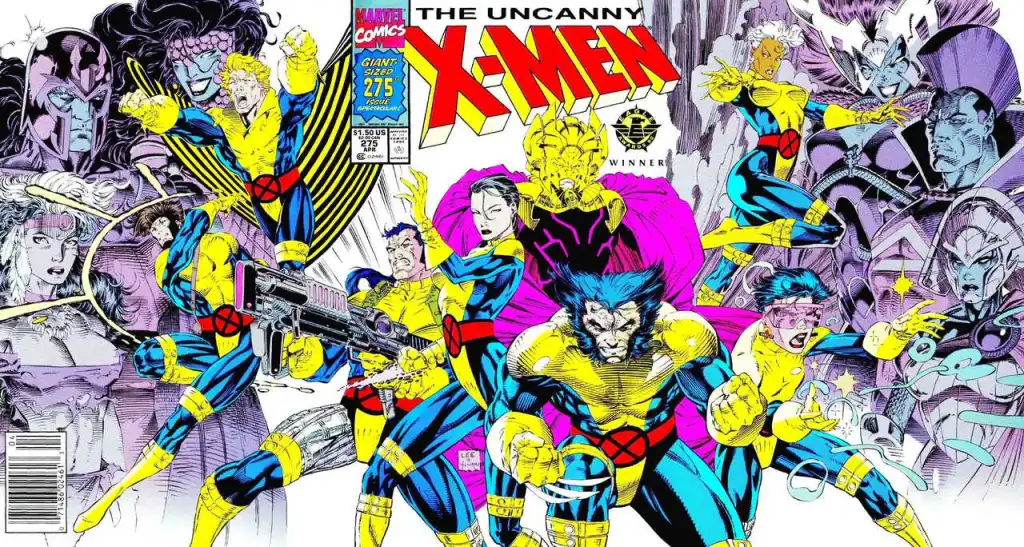
Scott Lobdell doesn’t get a lot of credit for how good his X-Men comics were, mostly because of his fumbles writing books at DC during the New 52. Lobdell was tapped to help script Uncanny X-Men after Chris Claremont left the book, and when Jim Lee and Whilce Potracio left Marvel to form Image, he was given the reins of Uncanny X-Men. Lobdell wrote Uncanny X-Men #286-350, Astonishing X-Men #1-4, X-Men: Alpha #1, X-Men: Omega #1, and X-Men: Prime #1, returning for issues #390-393. Uncanny X-Men was the bestselling book in comics, and Lobdell kept it at the top for much of the ’90s. Lobdell had his problems as a writer — he was one of the creators who kept adding open-ended plots to the X-Men and never actually closing them out — but he also understood the character dynamics of the X-Men. Lobdell wrote some great X-Men stories, and was one of the masterminds of The Age of Apocalypse. Go back and read some of Lobdell’s Uncanny issues, and you’ll see a writer who is much better than he gets credit for being.
7) Fabian Nicieza

Fabian Nicieza made a name for himself working with Rob Liefeld on X-Force, scripting Liefeld’s plots. After the Image departure, Nicieza was tapped as writer of X-Men (Vol. 2), putting out issues #12-45 and #86-87, as well as Amazing X-Men #1-4, and earlier work on Uncanny X-Men #279-280 and #366-367. Nicieza mostly worked with artist Andy Kubert, and gave readers some of the better X-Men stories of the ’90s. Nicieza got the characters, and was great at going in different directions that felt like the good old days of Claremont without completely copying the master. Of Lobdell and Nicieza, Nicieza is definitely the better writer. He took what he inherited from earlier writers and ran with it, giving X-Men fans a cool ride.
6) Jason Aaron
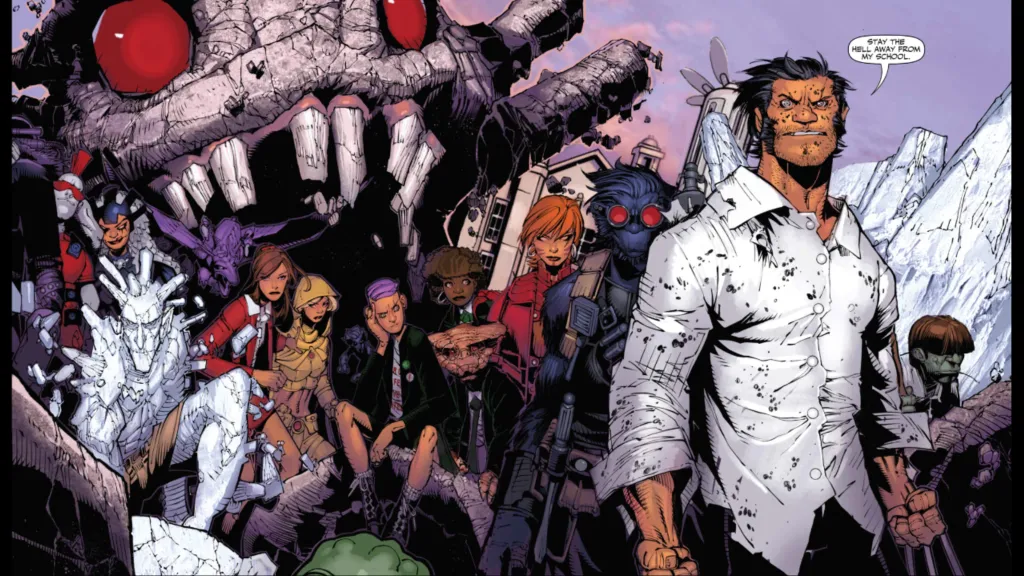
Jason Aaron first joined the X-Men office as the writer of the various Wolverine books of the late ’00s, where he made quite a splash. In 2011, Jason Aaron was the mastermind behind X-Men: Schism, a five issue X-Men event with Carlos Pacheco, Frank Cho, Daniel Acuna, Alan Davis, and Adam Kubert that split the X-Men in two. Aaron launched Wolverine and the X-Men (Vol. 1), which ran for 42 issues, and Amazing X-Men (Vol. 2) #1-6. Aaron worked with some amazing artists — Chris Bachalo, Nick Bradshaw, Ed McGuinness, and more — and brought readers back into the school life. Aaron was able to take ideas from the works of Claremont, Morrison, and his own work on Wolverine to tell character focused little gems of X-Men stories, making Quentin Quire a more fully realized character, and creating several great young X-Men like Broo. Aaron’s run was one of the brightest spots of ’10s X-Men book, a book that made people realize that Wolverine could actually lead a team.