Videos by ComicBook.com
Now, before we dive into this, we need to establish what we consider a supervillain. In the early days, Batman fought mostly common crooks and gangsters, but while they’re villains, they aren’t super, so we won’t be counting them. While the line between supervillain and regular criminal is dicey, we’re going to define this as someone with a theme. They have to have a central idea that goes beyond the scope of basic crime, such as mad science gadgets or an identity built around cats. Costumes aren’t required, but they help. With that said, let’s dissect Batman’s first ten supervillains.
10) Puppet Master
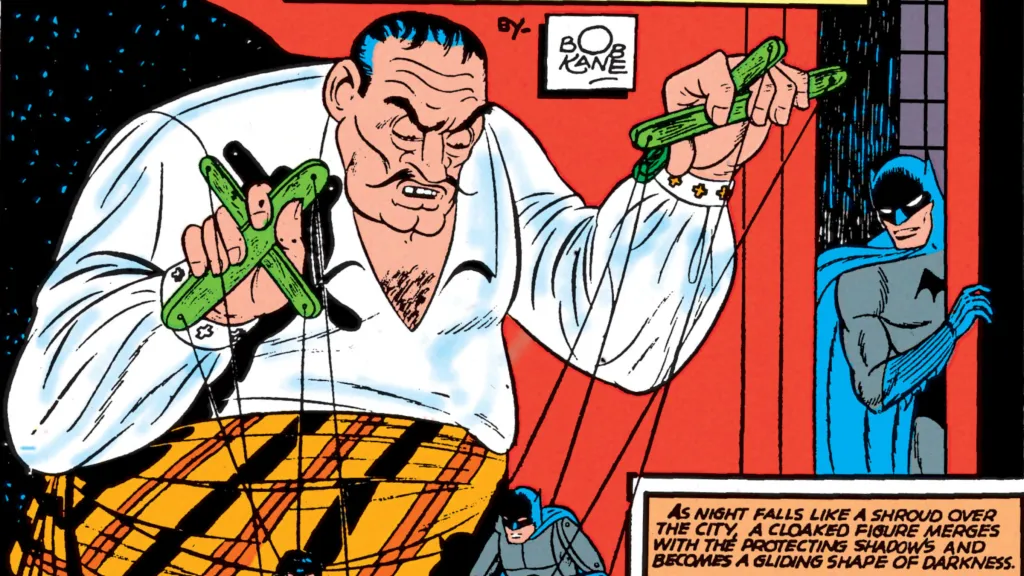
Debut: Batman (1940) #3
The Puppet Master was a criminal who led a gang of crooks, but he had a unique gimmick that put him on this list. He would have his men inject people with a Thought Serum that allowed him to mind-control them from a distance, and even managed to snare Batman with his power. Of course, Robin snapped Batman out of it, and the Dark Knight pounded the Puppet Master into prison. Unfortunately for the villain, this was his one and only appearance. He’s left no legacy beyond that story, so he has to take last on our list, despite his interesting powerset.
9) Painter of Death

Debut: Detective Comics (1937) #42
The Painter of Death was a banker named Wylie. He’d gotten into some serious debt, but discovered the unknown yet extremely talented artist Pierre Antal. Wylie convinced Pierre to paint Gotham’s socialites. Then, Wylie would don his Painter of Death outfit and murder the people Antal painted, hoping to foster a reputation for Antal predicting murders, thus making Wylie’s collection of his art worth a fortune. It’s no surprise that the Painter of Death only appeared once, given that this bit is way too specific to stick around, but he edges out Puppet Master for ninth place for inspiring a copycat murderer in Batman #38. So, technically, he did leave a legacy.
8) Three Devils
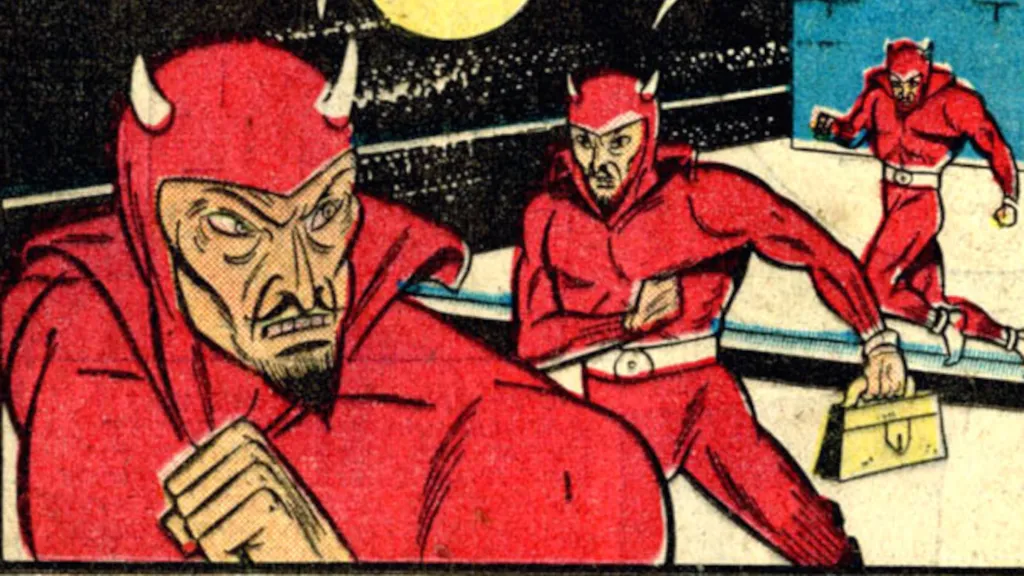
Debut: Detective Comics #50
The Three Devils were a group of former circus acrobats who dressed in devil costumes to steal jewels. They have the distinct honor of being the first trio of villains Batman fought, and the first on this list to appear as the villains in a second issue. They reappeared in the Silver Age in Batman #107, renamed the Daredevils, and fought Batman and Dick Grayson, who had been temporarily turned into an adult and went by Owlman. These villains didn’t leave much of an impact with their personalities, but their distinct look kept them in creators’ minds for at least a little while, as it were.
7) Doctor Death

Debut: Detective Comics #29
Doctor Death was originally a villain who specialized in chemical weapons, which he used to blackmail the wealthy and elite for his own gain. He battled Batman a few times over the years, but was never a prominent villain. In the Prime Earth continuity, Doctor Death was reimagined as a mad scientist who enhanced himself with a bone-growth formula, becoming a horrific monster that towered over the Dark Knight. Doctor Death has never been a mainstay, but he’s shown up often enough that people vaguely remember him. He might only be a D-List villain, but hey, he’s on the tier list.
6) The Mad Monk

Debut: Detective Comics #31
The Mad Monk was a vampire who once kidnapped Batman’s first love interest, Julie Madison. In fact, he was the villain of Batman’s first multi-part story. Although he’s only made relatively small appearances since then, the Mad Monk earns his spot on this list for how iconic he became. He is the face of this era of Batman, embodying how Batman was early in his career and dealing with a gothic, supernaturally inspired world. The sheer beauty of this cover definitely played a role, as it is one of Batman’s most iconic covers to date. The Mad Monk might not appear much on his own, but his legacy lives on as the face of this specific era for the Dark Knight.