Videos by ComicBook.com
They say imitation is the highest form of flattery, and with the parody genre, that couldn’t be more true. Not only does the genre provide hilarious mischief, but can also be a medium for thought-provoking reflection, critique, and commentary, even in a meta way. But whatever your flavor of fun be it an underlying deep metaphor or simply lighthearted shenanigans, you’re sure to find a favorite pick with this list of parodies!
1) Bobobo-bo Bo-bobo

In the year 300X, the world has been taken over and is ruled by the Chrome Dome Empire. The tyrannical rulers’ henchmen, the Hair Hunt Troop, mercilessly hunt the hair of all, leaving heads bald and cities in ruin. But there is one hero willing to stand up to the bald bad guys: Bobobo-bo Bo-bobo. Using his special follicle fighting style, Fist of the Nose Hair, Bo-bobo rebels against their depilated despotism. Along the way, he’s joined by friends Beauty, Gasser (Heppokomaru), and Don Patch to fight for hair justice.
With humor based in “wigging out” — “the art and philosophy of doing bizarre or unexpected things” — Bobobo-bo Bo-bobo thrives off absolutely wacky, random absurdity. As basically a parody of Fist of the North Star, the jokes and slapstick can even arguably become funnier out of context.
2) Gintama

Edo, a city once home to the feudal shogunate of Japan, is now a puppet-government after being invaded by an alien race, the Amanto. With the ban on swords in public, samurai have become a legend of the past. That is, except for one. Gintoki Sakata, brandishing a wooden sword, claims to be a samurai for hire despite the ban. But he isn’t alone; In his endeavor to help others, Gintoki stumbles upon Shinpachi Shimura who becomes his apprentice wanting to learn the way of the samurai and Kagura, an alien girl who assists with her superhuman strength.
As the trio take on freelance odd jobs at Yorozuya, there’s definitely emphasis on the capital ‘O’ Odd. From fighting aliens to toilet humor, Gintama doesn’t just have a longstanding high ranking as one of the best anime ever in general, but for good reason as the parodies are by no means fleeting, but ongoing.
Gintama can be streamed on Crunchyroll or Hulu where available.
3) KonoSuba

After dying a hilariously pathetic death out of sheer stress rather than being hit by what he thought was an oncoming truck, high schooler Kazuma Satou finds himself in an afterlife audience with the beautiful, obnoxious goddess, Aqua. Given two options — to either go to Heaven or be sent to a fantasy world — the shut-in NEET, of course, chooses the latter. He is also allowed to choose one thing to take with him, so he chooses Aqua, the goddess herself. Although being sent to another world as the future hero to defeat the Demon King seems like it would be full of adventure and wonder, Kazuma and the useless goddess actually end up spending much of their time working manual labor jobs and sleeping in a stable to just get by. Even so, their misadventure is only beginning!
KonoSuba: God’s Blessing on This Wonderful World!, or simply KonoSuba, is peak when it comes to parodying isekai. Constantly subverting expectations, Kazuma is a character who truly could not care to follow any typical tropes within the genre, leading to plenty of hysterical mishaps.
KonoSuba can be streamed on Crunchyroll.
4) FLCL

Naota Nandaba is an average, ordinary junior high schooler who feels as though nothing exciting ever happens in his city. After his brother Tasuku has left to play baseball in America, Naota takes it upon himself to look after things while he’s gone, like his bunk bed and ex-girlfriend Mamimi Samejima who constantly clings to him as a sort of placeholder for his brother. But when Vespa-riding, bass guitar-wielding, pink-haired psychopath Haruko Haruhara comes into his life, it’s anything but mundane. After whacking him in the head with her bass and kissing him, Naota ends up growing a horn on his head that he struggles to hide. Deciding to take up residence at his house, Haruko drags Naota into a battle he’d rather not fight.
With chaotic, confusing storyline and stylization, FLCL gives a wild experimental air, underlying metaphorical commentary, and pop culture references like that of the vaporwave aesthetic. While the series has its own brand of absurdity and tends to have a lot of Easter egg-like parodies, it also has its own gripping narrative on the struggles of puberty.
FLCL is available for streaming on either Max or Crunchyroll where available.
5) Magical Girl Ore
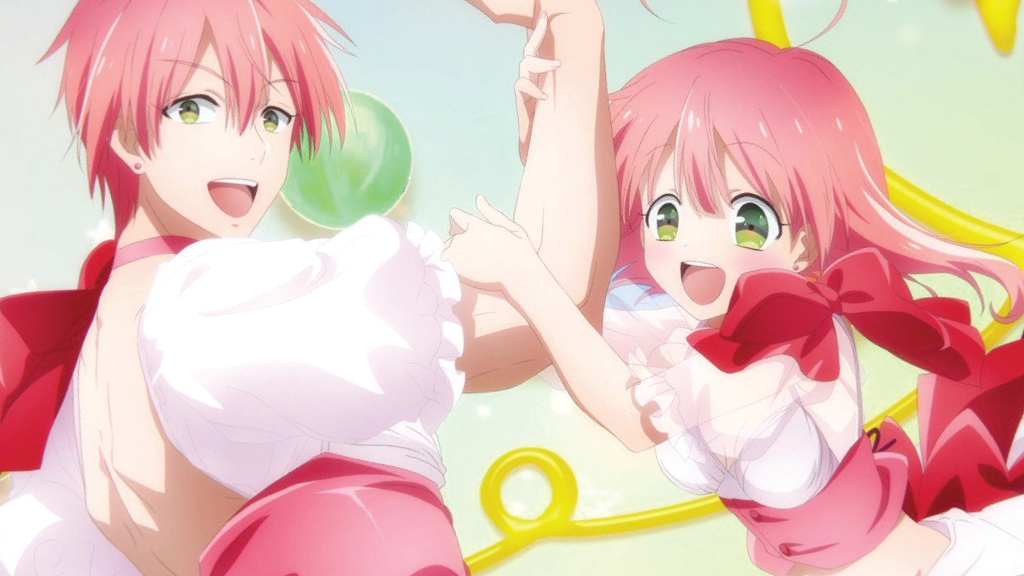
15-year-old Saki Uno, a member of the unpopular idol duo Magical Twins with her friend Sakuyo Mikage, wants to get close to her crush, Mohiro, Sakuyo’s brother. She may just get her wish when her mother introduces her to a yakuza-looking brutish man who tried forcing his way into their home and claims to be a Magical Girl mascot, Kokoro-chan. As Saki learns that her mother used to fight demons as a Magical Girl herself, Kokoro-chan says he’s seeking to recruit a replacement. Hesitant at first, Saki accepts when Kokoro-chan urges that Mohiro is a target for demons. Though her confession to Mohiro transforms her into a Magical Girl with Love Power, her transformative form isn’t what she expected. Regardless, Saki must team up with Sakuyo to protect Mohiro from the fluffy, buff demon squirrels.
A parody on the magical girl genre, Saki actually transforms into a buff man in a frilly dress. With her magical “Ore” form being a constant cause of embarrassment for her, her situation becomes further complicated when both her crush and best friend become attracted to it.
Magical Girl Ore is available for streaming on Crunchyroll.